Wednesday, December 31, 2014

A Victorian Holiday Menu

My Christmas dinner this year was a simple and low-key affair. But after the gifts were unwrapped and the guests departed, I began to wonder how my ancestors may have celebrated the holiday along the Erie Canal years ago, and what they may have prepared and eaten.

Queen of the Household - Title Page
I found a sample Christmas dinner menu in Great-Grandma Nan's 1891 book of household hints, Queen of the Household:

- Clam or Oyster Soup
- Celery
- Baked Fish with Hollandaise Sauce
- Roast Turkey with Oyster Dressing
- Roast Duck with Onion Sauce

- Baked Potatoes and Sweet Potatoes
- Baked Squash
- Mashed Turnips
- Canned Corn (This was a surprise; presumably home-canned.)
- Stewed Tomatoes
- Graham Bread; Rolls
- Salmon or other Salad

- Plum Pudding
- Peach Pie
- Fruit and Nuts

- Coffee and Chocolate

Queen of the Household - Frontispiece
I don't know how many guests this elaborate menu was intended to serve, but I surmise that it must have taken a kitchen full of helpers to prepare and serve such a repast, with three different meat and fish dishes (no, four if you count the salmon salad!), two kinds of potatoes, four vegetables, and three desserts.

Our modern hosts and hostesses may typically simplify this menu to perhaps serve only the following: turkey with dressing, baked potatoes and sweet potatoes, squash or another favorite vegetable, dinner rolls, a green salad, and a pumpkin or mincemeat pie, followed by coffee or tea.

Perhaps next year, if I am ambitious, I'll try out the recipe for plum pudding as a surprise treat for my family:

Christmas Plum Pudding:

"Shred finely 3/4 pound beef suet, and add to it a pinch of salt, 1 1/2 pounds bread crumbs, 1/2 pound flour, 3/4 pound raisins, 3/4 pound currants, picked and dried, 2 ounces candied lemon and citron together, and 1/2 a large nutmeg; mix these thoroughly, then add 4 eggs and milk enough to moisten it, but not too much or the pudding will be heavy; tie in a pudding-cloth, well floured, and boil for 5 or 6 hours [!]; or, we think better when boiled in a mold, which should be well buttered before the mixture is put in.  The mold should not be quite full, and should be covered with 1 or 2 folds of paper, buttered and floured, and then with a floured pudding-cloth."

I find it curious that in five different recipes for "plum pudding," none of the recipes actually includes plums. They list other fruits, such as tart apples, raisins, currants, and citron. Some also include nutmeg, brandy or sherry, and as in the Christmas Plum Pudding, chopped beef suet.

As I wondered about why a "plum pudding" would not contain plums, I checked the definition of "plum" in my American Heritage Dictionary, and found a less-well-known meaning: "A raisin, when added to a pudding or cake." That answered my question about "why no plums in a plum pudding."

Rather than attempt such an elaborate dessert for my next holiday dinner, I might try a simpler recipe from Grandma Nan's cookbook: Poor Man's Pudding  --  "Take 1 quart milk, 6 eggs, 6 tablespoons flour, and a little salt; bake 1/2 hour; use butter and sugar dip." Or better yet - an instant chocolate pudding from the supermarket . . . !

Sunday, December 14, 2014

Short Days, Long Nights

The shortest day of the year, the winter solstice, is only a week away. In a frenzy of consumerism, Americans are frantically shopping for gifts. I got ahead of the game this year, and mine are already wrapped and hidden away until the big day on Christmas.

But the Dutch and many Dutch-Americans have already had a fun- and goodie-filled celebration  --  Sinterklaasavond, or Saint Nicholas Eve.

As Saint Nicholas Eve (December 5) coincides with my birthday, my childhood memories of the day are a blurred combination of birthday cake, and wooden shoes filled with chocolates, nuts, and oranges.

Dutch Settlers Society Celebration:

This year, as for the past five years or so, I attended the annual Saint Nicholas Eve dinner of the Dutch Settlers Society of Albany. There was good food, music, and much gezelligheid (a Dutch word that connotes comfort, coziness, and camaraderie), a talk by Albany's Mayor about the city's rich history  --  and to top off the evening, the traditional visit by Saint Nicholas, or Sinterklaas, as he is known in Dutch.

Sweet Treats:

I also had an opportunity this week to attend a talk by Dutch food historian Peter Rose about the history and origin of Saint Nicholas lore, and the traditions connected with the celebration of this feast day, including the many recipes for tasty treats prepared for the fete.

If you have a sweet tooth like I do, you will want to try out such dainty delicacies as speculaas, most often known in the United States as "windmill cookies."

Family Mystery Solved:

Years ago, my Mom had a pair of bas-relief wooden carvings that we knew were of Dutch origin. I had a vague memory of these artifacts being displayed in the house I grew up in. And so it happened that my sister unearthed the pair, "hidden in plain sight," in the basement of the house.

The red-painted carved boards, about 13 inches by 4 1/2 inches, represent a quaintly dressed young man and woman. It was obvious to me that they were similar to the cookie boards representing Saint Nicholas and other Dutch symbols used to mold cookie dough around the holiday. But why a boy and girl? Was there a particular significance to the pair?

I learned during the talk that the paired figures are known as vrijers, or "lovers," based on the legend of the Saint's anonymous gift of dowries to three sisters whose father was too poor to provide them with the requisite sum. In this fashion, Saint Nicholas made it possible for the young women to marry.

How old are the pair of vrijers that turned up in the basement? I have  no idea, but I don't dare to try filling them with sticky cookie dough. They will, however, be a unique piece of holiday decoration this year, and a great conversation starter.


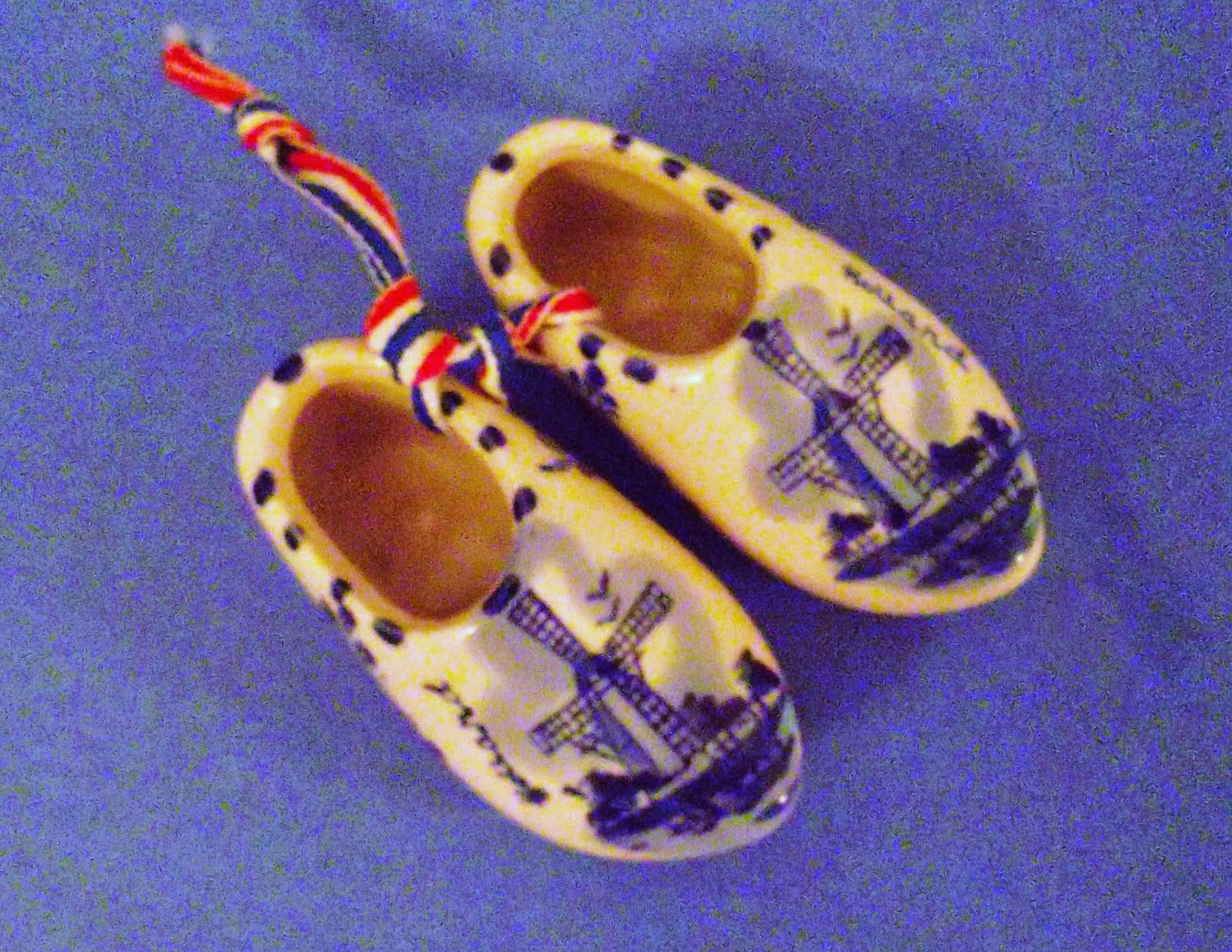
My shoes are waiting for Sinterklaas's visit!


Sunday, November 30, 2014

"Guests Raved About Her Dinner!"

Spry Cookbook - Front cover
"What Shall I Cook Today?" is the title of yet another vintage cookbook that I found in the kitchen at the old homestead. This one is a collection of recipes using the brand of vegetable shortening Spry, which was available in grocery stores between the mid-1930s to the mid-1960s. According to the brightly colored drawings that decorate the booklet's covers, "Guests raved" about dinners prepared with this canned shortening.

Published by Lever Brothers Company in Cambridge, Massachusetts, the booklet is undated, but judging from the clothing styles depicted on its colorful front and back covers, I would date it either late 1940s or early 1950s. The book contains 124 "thrifty healthful tested recipes"  --  consistent (health and thrift) in appealing to homemakers returning to the hearth after working in factories and offices while their men were fighting in World War II; consistent also with post-WW II ideals of the feminine mystique.

Deep-fried Fritters
The section on deep frying begins with a recipe for Apple Fritters, reminiscent of either Grandma VandenBergh's or Grandma Minnie's recipe; this one describes dipping apple slices in a batter of flour, baking powder, salt, egg, milk, and of course frying them in Spry. These fritters are seasoned with sugar, cinnamon, and nutmeg.

A recipe for Corn Fritters fried in a similar fashion is described thus: "Make plenty  --  everyone will surely want seconds."

Other sections in the booklet include shallow frying, sauteing, cakes, frostings, cookies, and breads, but the longest section in the book is devoted to all sorts of pies and fruit tarts. There are both two-crust pies and one-crust pies. A sticky note on the page with the recipe for Blueberry Nectar Pie indicates that our Aunt Doris used this recipe to concoct the delicious blueberry pie that was always served at our traditional family dinner on Thanksgiving, made with berries harvested from Doris's blueberry bushes in the summer and frozen until the big day in November.

Mom also always made her own pie crust dough from scratch, cutting the shortening into the flour with a pastry blender or two knives as described in this booklet: "Do not handle dough anymore than necessary"  --  to keep it light and flaky.

Spry Cookbook - Back cover
The booklet include instructions for making a Spry Pastry Mix, so that the homemaker "can have oven-fresh pies at a moment's notice." The mixture contains one pound of Spry, two pounds of flour and one tablespoon of salt; it will keep in a covered container "for an indefinite length of time." This mixture is described as "The greatest 'shortcut' in the history of pie-making. Pie crust enough for a month  --  and all in a single mixing job!" (How many pies was the 1950's-era homemaker expected to make in a month?)

Today's busy homemaker has an even greater shortcut  --  ready-made pie crust from the dairy section of the local supermarket. I suspect that many more Thanksgiving pies are made by using this commercial dough than entirely from scratch. I confess that I used it myself to try out a recipe from this booklet:

"Eccles": When I saw this word at the bottom of a page, I had no idea what it meant. This type of pastry is described as, "Titbits [sic] from your left-over pastry":

"Roll pie crust thin and cut in small circles. Place a spoonful of mincemeat or jam or fruit in center. Wet edges. Place another circle on top and press edges together. Crease three marks across top, turn, and repeat. Bake in hot oven (425 F.) 10 to 15 minutes, or until golden brown."

I was curious about the origin of this pastry treat, as well as its name. It is apparently named after the English town where it originated, Eccles in Lancashire, where a baker named James Birch began selling small, flat, raisin-filled cakes in 1793. Birch's recipe was similar to one that was included in an earlier cookbook, by Elizabeth Raffald, "The Experienced English Housekeeper."

I baked a batch of Eccles cakes and shared them with friends. The pastries were filled variously with raspberry, blueberry, and mango jam. My friends didn't exactly rave about them, but they did have seconds. (At least, I did!)


Eccles Cakes  -- fresh from the oven


                                                     *        *        *

Learn more about the origin of Eccles cakes at: http://www.salford.gov.uk/ecclescakes.htm

Sunday, November 23, 2014

Two Dutch Soup Recipes

Once again, chilly temperatures have put me in a soup-making mood. I searched through Grandma VandenBergh's old Dutch cookbook and found two recipes to try out:

Cauliflower Soup   (Bloemkoolsoep)

1 L. water (about 1 qt.), in which cauliflower has been cooked, with pieces of cauliflower in it
40 gr. (1/4 cup) whole wheat flour
40 gr. (2 tablespoons) butter or margarine
1 egg, beaten

- Use the water in which the cauliflower has been cooked, leaving a few chunks of cauliflower in it.
- Bring the water to a boil.
- In the meantime, heat while stirring the butter with the flour to form a smooth paste ("een gladde massa" in Dutch)
- Stir the boiling water and cauliflower into the butter and flour paste and let simmer for 10 minutes.
- Beat the egg in a soup tureen and carefully stir the soup into this mixture.
- Garnish with croutons or serve with whole wheat toast.

My first experiment with this recipe entailed using an unusual variety of purple cauliflower that I came across in a local farmers' market:

Purple cauliflower


This soup turned out with a pleasant shade of pink, but somehow it didn't seem very appealing to me!

Purple cauliflower soup


But ordinary while cauliflower worked out just fine:

Cauliflower Soup


Leek Soup (Preisoep)

The ingredients and preparation of this soup are quite similar, except for the leeks, of course:

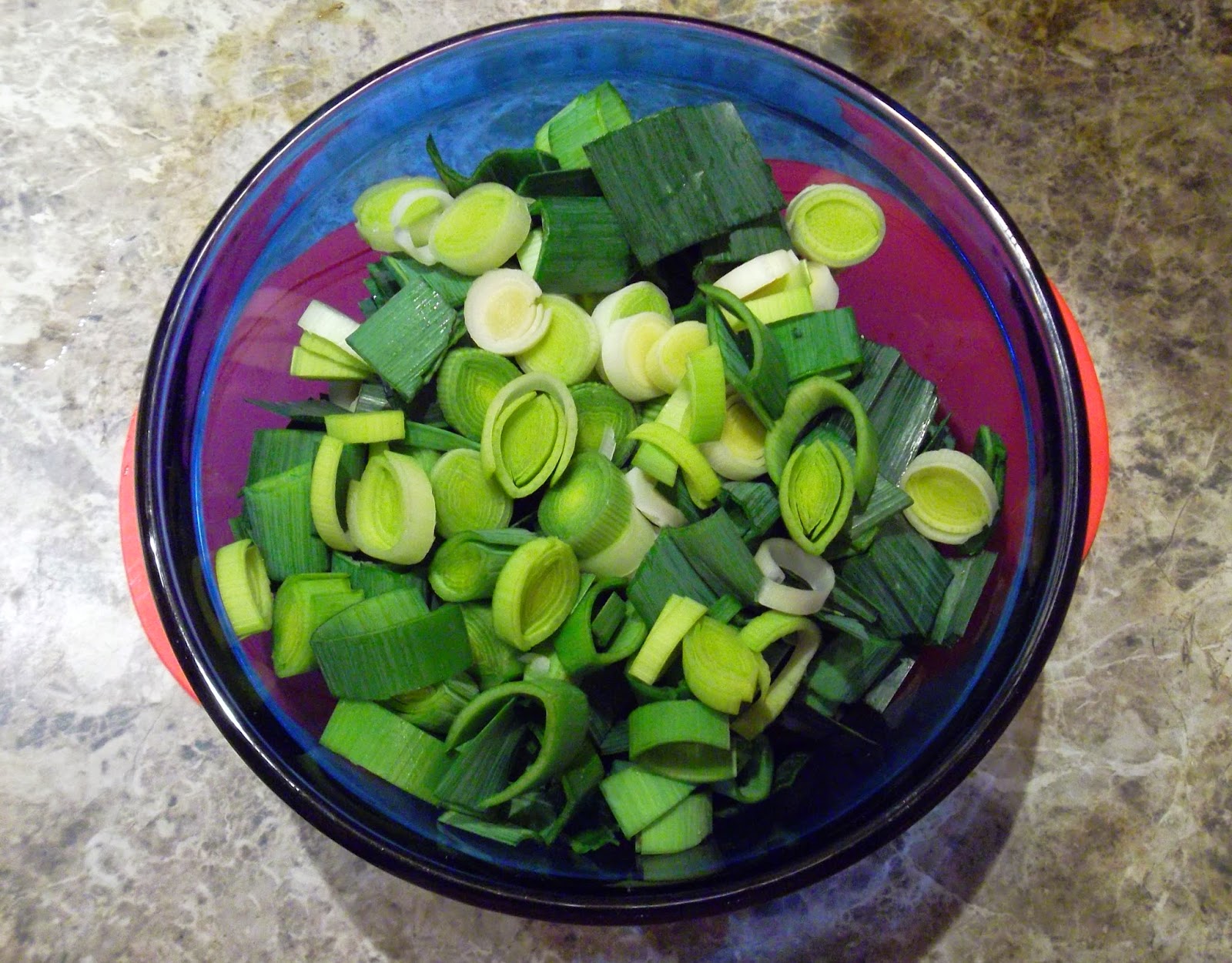
Chopped leeks
1 L. (about 1 qt.) water
7 1/2 gr. salt (1 1/2 teaspoons; I used only 1 teaspoon)
4 large or 6 small leeks
35 gr. (about 1/4 cup) flour
40 gr. (2 tablespoons) butter or margarine
2 teaspoons Arome Maggi or soy sauce
1 egg, beaten

- Chop the leeks into one-inch or half-inch pieces and cook in the salted water.
- In the meantime, melt the butter and stir in the flour, forming a paste.
- Slowly pour the liquid with the leeks into the flour and butter mixture, stirring to prevent lumps from forming.
- Let the soup simmer for about 10 more minutes until cooked through.
- In a soup tureen, beat the egg with the soy sauce.
- Stir in the liquid mixture and serve with croutons or toasted bread.

I altered the recipe a bit to add chunks of potato, to make it a bit more substantial. If you add a few bacon crumbles and consume it with whole wheat or rye toast, you'll have a whole meal:

Potato and leek soup


Eet smakelijk! Enjoy your meal.

Sunday, October 26, 2014

K is for "Kabeljauw"

Grandma Vanden Bergh's Dutch cookbook contains a chapter of recipes on how to prepare a variety of fish. That's not surprising, since the Netherlands has always been a seafaring nation, and freshwater fish also abound in its rivers.

I have tried cooking codfish from my local supermarket, but it most often tastes bland and unappetizing. I decided to try out this 1920's recipe, and found it a tastier dish than the earlier attempts I made on my own:

Baked Codfish    (Gestoofde Kabeljauw)

2 codfish fillets (about 1 kg; 2 pounds)
60 grams butter (That is 1/4 lb. I used about half that amount - of margarine.)
1/2 lemon
salt to taste

- Clean the fish in the usual way, salt the fillets and place in an ovenproof dish.
- Pour about 1 cm. (1/2 inch) of water into the dish, into which a "Cube Maggi" is dissolved, if you wish. [If "Cube Maggi" is not available, use a vegetable-flavored bouillon cube.]
- Squeeze the juice of 1/4 of a lemon over the fish and dot with butter.
- Sprinkle with breadcrumbs; lay 2 slices of lemon over the fish.
- Bake at 350 F. (175 C.) covered for 20 minutes, then uncovered an additional 10 minutes.

I served the cod with potatoes and green beans, which made a balanced meal.

Baked codfish

Eet smakelijk!  --  Enjoy your meal.

                                                              *        *        *

For another fish recipe from Grandma Vanden Bergh's cookbook, see the earlier post, "The Way of All Fish."

Sunday, October 5, 2014

More History Events

Schenectady Stockade District
This weekend I had the opportunity to attend two more history events. On Saturday I went to a Genealogy workshop at the Schenectady County Historical Society. There were four presentations.

The first was about using university archives and special collections for doing genealogical research. It hadn't occurred to me that there may be a great deal of information, for example, about the daily life of my relatives who attended college in the 1920s or 1940s in the records of the institutions they attended. A rich resource to be explored on a rainy afternoon!

The second presentation gave the attendees some tips for searching ancestry.com ; always a useful refresher for those who have tried this on their own.

The most useful presentation for me showed us how to browse through the wealth of historical information posted at a Web site developed by a research librarian at the Schenectady County Public Library. The library hosts a digital history archive which truly a cornucopia of resources that have been posted online. You can find this at http://www.schenectadyhistory.org .

The last presentation walked the participants through the resources available in the Grems-Doolittle Library of the historical association, which includes a collection of print and digital resources, including an historic manuscripts collection. The Society is located in the historic stockade district near the Mohawk River in Schenectady.

Half Moon Replica Ship on the Hudson
On Sunday, I went to the shore of the Hudson River in Albany, to tour the replica of Henry Hudson's ship, the Half Moon (Halve Maen in Dutch). The replica was constructed about 25 years ago, and is a full-scale, working model of the type of sailing vessel used by the Dutch East India Company in the 17th century. While touring the ship dockside, it was difficult to imagine how such a tiny, cramped vessel crossed the Atlantic Ocean safely.

The replica operates as a floating museum, with a crew of volunteers who welcome student sailors from local middle schools and exchange students from the Netherlands  --  a wonderful opportunity for a living history lesson!

The tour guides showed us the forecastle, where the cooking stove was located; the crew's quarters; and the area where trade goods were stored.

Stove and food samples


Storage for trade goods in the ship's hold 
Crew's quarters

                                                               *        *        *

To learn more about Henry Hudson and the Half Moon, here are a couple of books that look at the voyage from different perspectives:

Henry Hudson and the Algonquins of New York, by Evan T. Pritchard. This volume attempts to recreate the Half Moon's voyage up the Hudson river from the perspective of the Native Americans with whom the ship came into contact.

Half Moon: Henry Hudson and the Voyage That Redrew the Map of the New World, by Douglas Hunter. This book focuses on the history behind the quest for a water route through North America to the Pacific Ocean, and the economics and politics of the era.

Sunday, September 28, 2014

A Month of History Events

This month there have been quite a few history events here in New York's Capital District. Here's a list of the ones I have attended:

- Sunday, September 14, 2014: 90th Anniversary Celebration of the Dutch Settlers Society of Albany. The DSSA was founded in 1924, in connection with the celebration of the tercentenary of the settlement of the City of Albany. Its mission is to: perpetuate the memory of the individuals who resided here during the time it was a Dutch colony; collect and preserve records and information concerning the history and settlement of Albany and its vicinity, including genealogical records of the settlers and their descendants; and to foster the study of the early history of the City of Albany.

The anniversary luncheon took place at the Stockade Inn in the city of Schenectady, with fifty members and friends in attendance. The Mayor of Albany, the Honorable Kathy Sheehan, was an honored guest.  A speaker from the Historic Albany Foundation gave an illustrated talk on what the city of Albany was like in 1924, when the Society was founded. Attendees found the table of DSSA memorabilia an interesting trip through the Society's history. An album of photos taken at the celebration can be found here.

Friday, September 19, 2014: Talk and book-signing by Professor Susannah Shaw Romney, at the Albany Institute of History and Art, about her recently published volume, New Netherland Connections: Intimate Networks and Atlantic Ties in Seventeenth-Century America. I found a brief mention of my ancestor Cornelis van Slijck in her book, so I could not resist purchasing it!

Saturday, September 20, 2014: New Netherland Institute Seminar, at the New York State Museum. The Seminar featured speakers from several universities in the United States as well as from the Netherlands. There were 150 attendees this year, who filled the auditorium with their enthusiasm. Following the seminar, attendees enjoyed a dinner at Albany's historic Fort Orange Club.

Indian Statue in Schenectady Stockade Area
Saturday, September 27, 2014: 54th Annual "Stockade Walkabout" in Schenectady, NY's historic stockade district, sponsored by the Stockade Association and the Schenectady County Historical Society. The buildings on the self-guided walking tour represent three centuries of local architecture and history. Of course, there are few, if any, buildings that date from the 17th century left, but there are indeed several that were originally built during the early 18th century. In contrast with nearby Albany, Schenectady's business sector moved away from the area of the original settlement, leaving the oldest part of the city mostly residential, which surely saved many old homes from being torn down to set up businesses.

I was particularly interested and intrigued to see the names of a couple of my ancestors on historical plaques adorning homes along one street. The plaques indicate where the original homes were, but are on structures that were built later than those inhabited earlier by the original settlers:


And another plaque indicated the location of Jacques van Slijck's early tavern, near a narrow street known as Cucumber Alley:


One of the oldest houses in the city of Schenectady is the Yates house; it dates from the early 18th century:

Abraham Yates House


Halve Maen Replica Ship
Sunday, September 28, 2014: Early Albany Hudson River Festival. At this day-long festival and encampment, the replica ship of Henry Hudson's 1609 voyage of exploration, the Half Moon, or "Halve Maen" in Dutch, lay at anchor in the river. We also saw demonstrations of 17th-century handcrafts and technology, such as a cooper, blacksmith, and broom-maker. Members of the Stockbridge-Munsee band of Native Americans were also present to interpret current and past practices of their tribe.

It was right around the third week of September 1609 that Hudson's ship reached the area near present-day Albany, in the heart of what was then the main population area of the Mahican Indians. As the replica ship floated near the riverside park, it was tempting to try to visualize what the scene may have looked like four hundred years ago. The replica ship is a floating museum, with a multinational crew of volunteers and student sailors.

Mahican Wigwam Replica at Hudson River Encampment

The Half Moon will still be docked in Albany for the next couple of weekends. Perhaps I'll have an opportunity to tour the ship to get an idea of what it must have been like aboard for Hudson and his crew.