Sunday, November 25, 2012

Over the River


It is 6:30 A.M. on Thanksgiving morning. The sun is coming up over the village of Fort Plain, with a wide wedge of bright pink high in a robin’s-egg-blue sky. It is 28 ยบ Fahrenheit outside, and quiet except for the barking of a dog down the street. As the sky grows lighter, the town clock rings seven times, as it has for over a hundred years.

As far back as I can remember, we used to come over the river and through the woods to feast on turkey and stuffing with four generations of Grandma Minnie’s extended family. This year, those of us who have inherited the old homestead  --  the younger generation that has now become the older generation  --  have decided to revive the family tradition of Thanksgiving at the family home. Brother and Sister are bringing the stuffing and other trimmings, Daughter is bringing pie, and yours truly is cooking the turkey.

Path up the hill
While the turkey sizzles in the oven, I take a walk up the winding path to the top of the hill at the edge of the cemetery. With most of the leaves gone from the trees, I can see over the river to the other side of the wide valley. Thousands of years ago, the spot where I am standing was the bank of the mighty Iro-Mohawk River formed from the melting of the glaciers. Now it is a steep terrace that affords a panoramic view of the neighborhood and the ridge across the river:

View across the river from the cemetery ridge
Along that ridge, Native Americans built their palisaded villages, later Palatine Germans spread their farms, and yet later an early 20th century aviator landed his plane.


Great-Grandpa Fred and horse Maud
I look down at the house and see in my mind’s eye the barn where Great-Grandpa Fred kept his horse a hundred years ago, and the woodshed where fifty years ago my childhood self shed her boots when we arrived for the Thanksgiving feast. The barn and the woodshed are both gone now. Gone as well are most of the people who gathered around the table that half-century ago, buried only a few feet from where I stand as I look down at the house and over the river.

The house seems smaller than it did to me as a child, but of course everything seemed larger when I was small. This home and its earlier inhabitants shaped some of my most vivid childhood memories. Now, coming home to another Thanksgiving has given our family an opportunity to shape some new memories with today’s younger generation. 

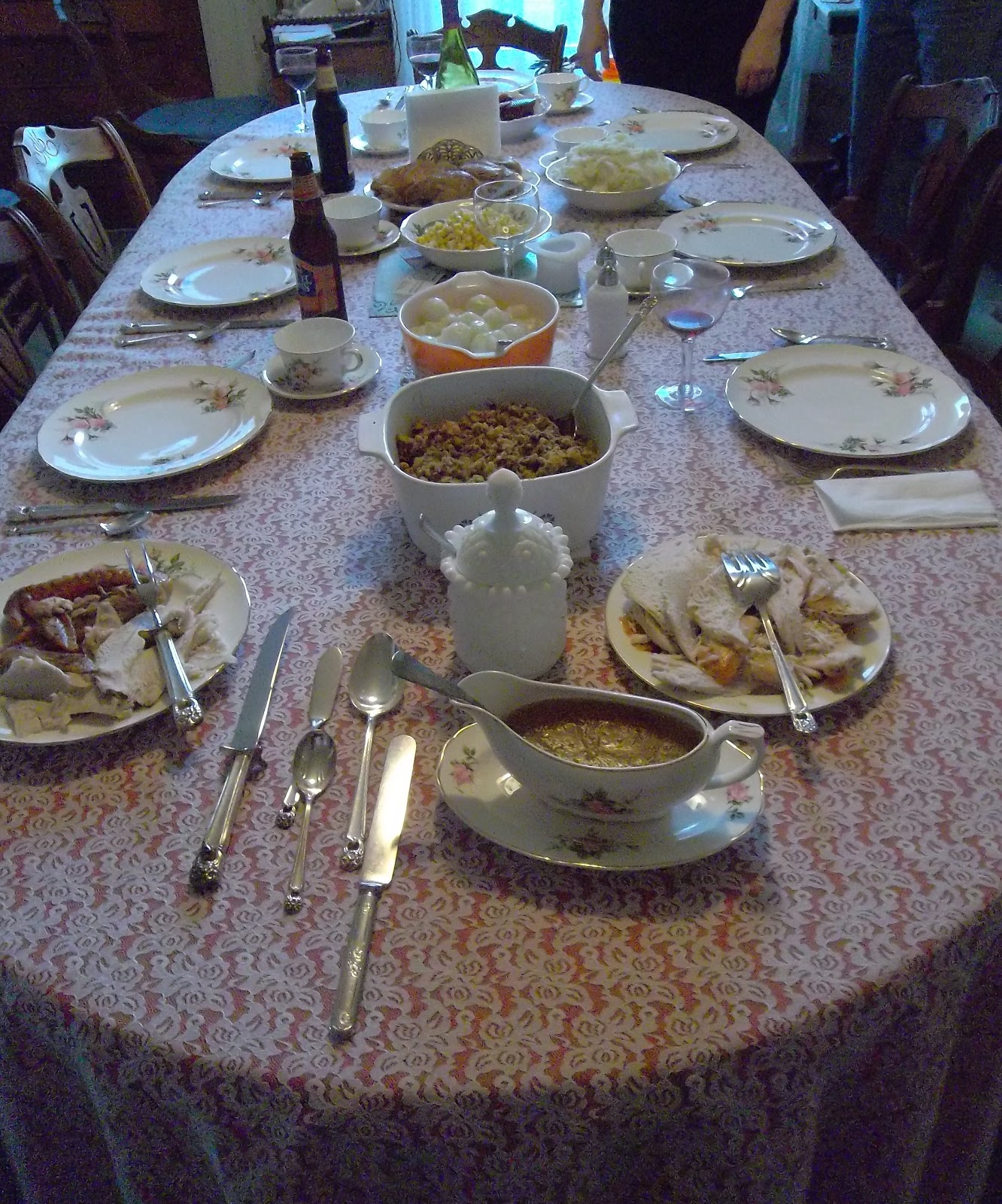
The table laid with this year's feast

Sunday, November 18, 2012

Asparagus Dutch Style

Grandma VandenBergh's Dutch cookbook, "Eenvoudige Berekende Recepten," has a recipe for a vegetable dish with white asparagus. We don't see this delicacy much in our part of the United States  --  it's considered a gourmet version of the more usual green asparagus. But the white variety is more common in western Europe, including the Netherlands. Although very bitter when sampled raw, it has a delicate flavor when steamed or boiled.

White Asparagus Recipe

- 2 bunches of white asparagus
- 2 hard-cooked eggs
- 75 grams (1/3 cup) butter or margarine
- grated nutmeg to taste

Cut or break off the hard ends of the asparagus stalks. Scrape or peel the remaining parts (do not peel the tips).

White asparagus


Tie the asparagus stalks into bunches of 10 or 12 pieces and cook thoroughly in boiling water with a pinch of salt (about 30 minutes).
Remove with a skimmer or slotted spoon and place on a serving plate with the tips all pointing in the same direction.
Snip off the string. Granish with slices of hard-cooked egg.
Drizzle with melted butter or margarine and sprinkle with nutmeg.

Asparagus garnished with butter and nutmeg

As the Dutch don't like to waste anything, the recipe also suggests using the cooking water and the cut-off ends to make soup. I had run out of eggs, so my version was egg-less. Incidentally, I found a very similar recipe in the bilingual (Dutch & English) cookbook I had bought in the Netherlands last year, which included ham and potatoes to round out the meal. So the Dutch have been eating this white asparagus for at least a hundred years, probably much longer!


Eet smakelijk! Enjoy your meal.


Sunday, November 11, 2012

A Ceremony in Loosdrecht -- 1949

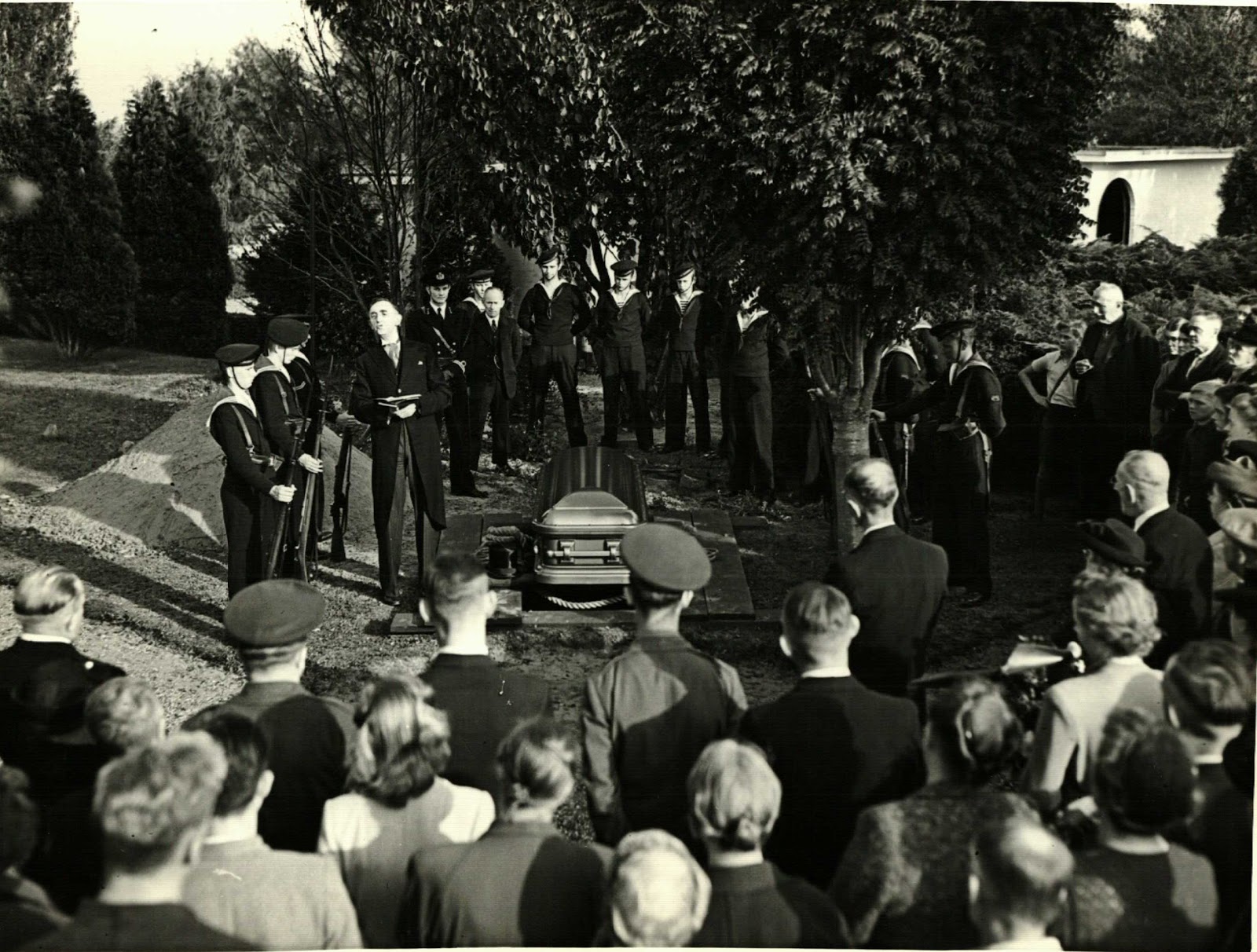
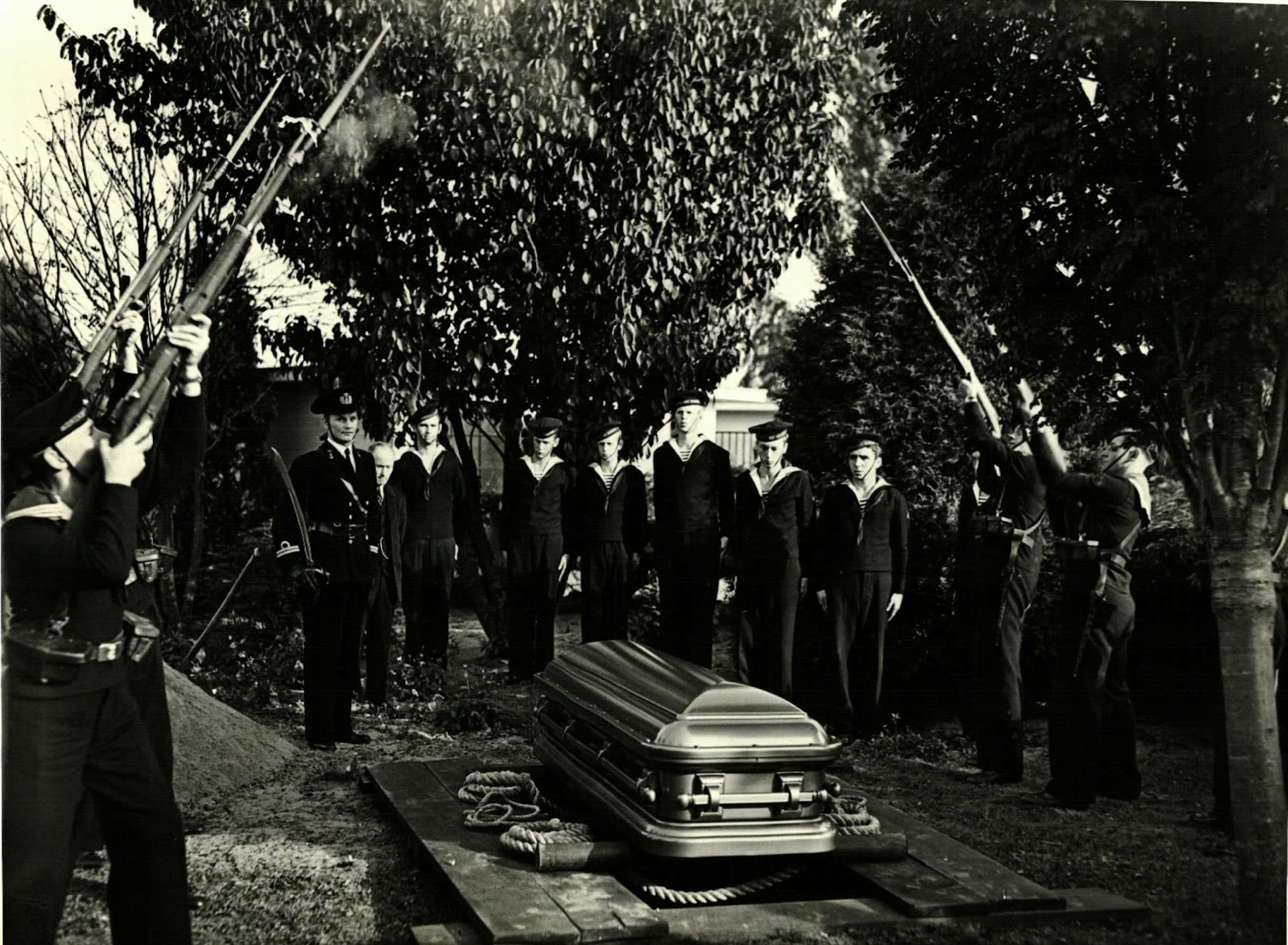
Some time ago I came across a series of old photos of a military ceremony in my grandmother's hometown, Loosdrecht, Netherlands. Although they were not in attendance, this was a very personal ceremony for Grandma and Grandpa VandenBergh  --  the reburial of their son Jasper, born in Albany, and who with his elder brother Jacob, fought as an American soldier during World War II.

Unlike his elder brother, Jasper never came home. He was killed at the Battle of the Bulge and originally buried near there. After the war, the family decided that it would be more appropriate for his remains to be repatriated  -- not to America, but to Grandma's hometown of Loosdrecht. In a somber ceremony attended by local dignitaries, members of both Grandma and Grandpa's extended families, and other villagers, Jasper was laid to rest in the Loosdrecht-Rading Cemetery. Mom carefully preserved the photos, along with Jasper's Purple Heart. I thought it appropriate to post the photos today, which is Veterans Day in the United States.


Led by the Dutch Commandant, the cortege enters the cemetery


The cortege approaches the grave site


The Dutch Officer Speaks


The Dominie (Pastor) reads from the Bible


Jasper's cousins, aunts, and uncles gathered around the grave site


An official lays flowers at the grave


An official of the Dutch War Cemetery Committee lays a wreath


A salute by the Dutch Navy honor guard


The casket is lowered into the grave


Jasper's uncle (also named Jasper) thanks the attendees for coming


During my trip to the Netherlands last year, I made a point to visit Jasper's grave site  --  the uncle I never knew. Read more about that occasion at the earlier post entitled "Uncle Jasper."

Sunday, October 28, 2012

Dutch Apple Fritters

It's the apple picking season in Upstate New York, and although the apple crop was not as good as usual due to the drought the region suffered during last summer, you can still find your favorite varieties in the supermarket or at farmer's markets during many a weekend.

Try using tart Granny Smith apples for the recipe below from Grandma VandenBergh's old Dutch cookbook:


Granny Smith Apples
Dutch Apple Fritters

- 125 grams (1  1/4 cups) whole wheat flour
- 2 dL. (3/4 cups + 1 tablespoon) carbonated water
- 2 grams (1/4 teaspoon) salt
- cooking oil
- 2 or 3 sour apples


Mix the carbonated water and salt with the flour as quickly as possible, to form a smooth batter.
Core and peel apple; slice into round slices.
Using a long-handled fork, dip the apple slices in the batter and place them in the hot oil.

Sizzling fritters

Fry until crisp and golden brown.
Drain on paper towels and serve warm, sprinkled with powdered sugar.

Fritters are ready to eat!


Take care that the whole process is done as quickly as possible, so that the seltzer water does not become flat, so that the fried dough remains light and fluffy.

 (Are the cored apple slices the origin of our American donuts with holes in the middle? I wonder!)

The next recipe in Grandma VandenBergh's cookbook indicates that you can make the same type of fried "beignets" with a cup of apricots.  In that case, wash the apricots and soak them in water for a couple of hours, then simmer in the same water for about 10 minutes. Drain and coat with granulated sugar before dipping in the batter and frying as for the apple fritters.

The apple recipe is somewhat similar to the Apple Fritter recipe in Grandma Minnie's handwritten notebook. Interesting that both of my grandmothers may have made similar treats for their families. Although the method of preparation was quite different, the result must have been similarly tempting.

Eet smakelijk! Enjoy your meal.

Monday, October 22, 2012

The Education Building Turns 100

New York State Education Building

A feud between a Commissioner and a Bishop, a colonnade of massive marble pillars, a cardinal entombed in stone  --  these are the mythic elements of the New York State Education Building's genesis, which is celebrating its centennial this month.

When my grandparents arrived in Albany in May 1911, the building was still under construction. Nestled behind its over-sized frame, the Episcopal Cathedral of All Saints appeared small by comparison. Therein lies the first drama related to the building's construction.

Nave of Cathedral of All Saints Cathedral
Bishop William Doane, first Episcopal Bishop of Albany, dreamed of creating an English cathedral community complete with school, hospital, convent and church. In the spring of 1882, the Bishop announced a competition for the design of a cathedral, having acquired the site on which the the church now stands. However, he was unable to persuade the church trustees to purchase the adjoining land on Washington Avenue, where he hoped to place the other elements of the cathedral community.


Enter Andrew Sloan Draper, first Commissioner of Education, who had his own dream: a government building entirely devoted to education, and on a grandiose scale such that it would impress the population with the importance that education should hold in the Empire State.

Both men had their eyes on the same piece of prime real estate across from the Capitol Building. Both men played important roles in the community's life, and both had a plan and a vision for the use of the land. But only one won out: Commissioner Draper.

Rotunda of Education Building
And then the competition was on to select the design that would stand as a symbol of the importance of education. Sixty-three architects submitted plans. The winning design was that of Henry Hornbostel, who had studied architecture in Paris. If you ever have a chance to tour the building, you might notice that the second floor room that was originally the reading room of the New York State Library was pretty much copied after that of the Biblioteque Nationale (National Library) in Paris.

 Construction was begun in 1908, and continued for four years.

The most impressive exterior element is of course the block-long colonnade of 36 massive marble pillars. But let me tell you a secret: they are not solid marble; they are constructed with a Vermont marble facing over steel shafts. Although it was probably the impressive design of the fluted colonnade that won Hornbostel the contract, there was some controversy involved. The columns are of Corinthian style, but Hornbostel modified the classical design by adding some reverse volutes not used by the Greeks.

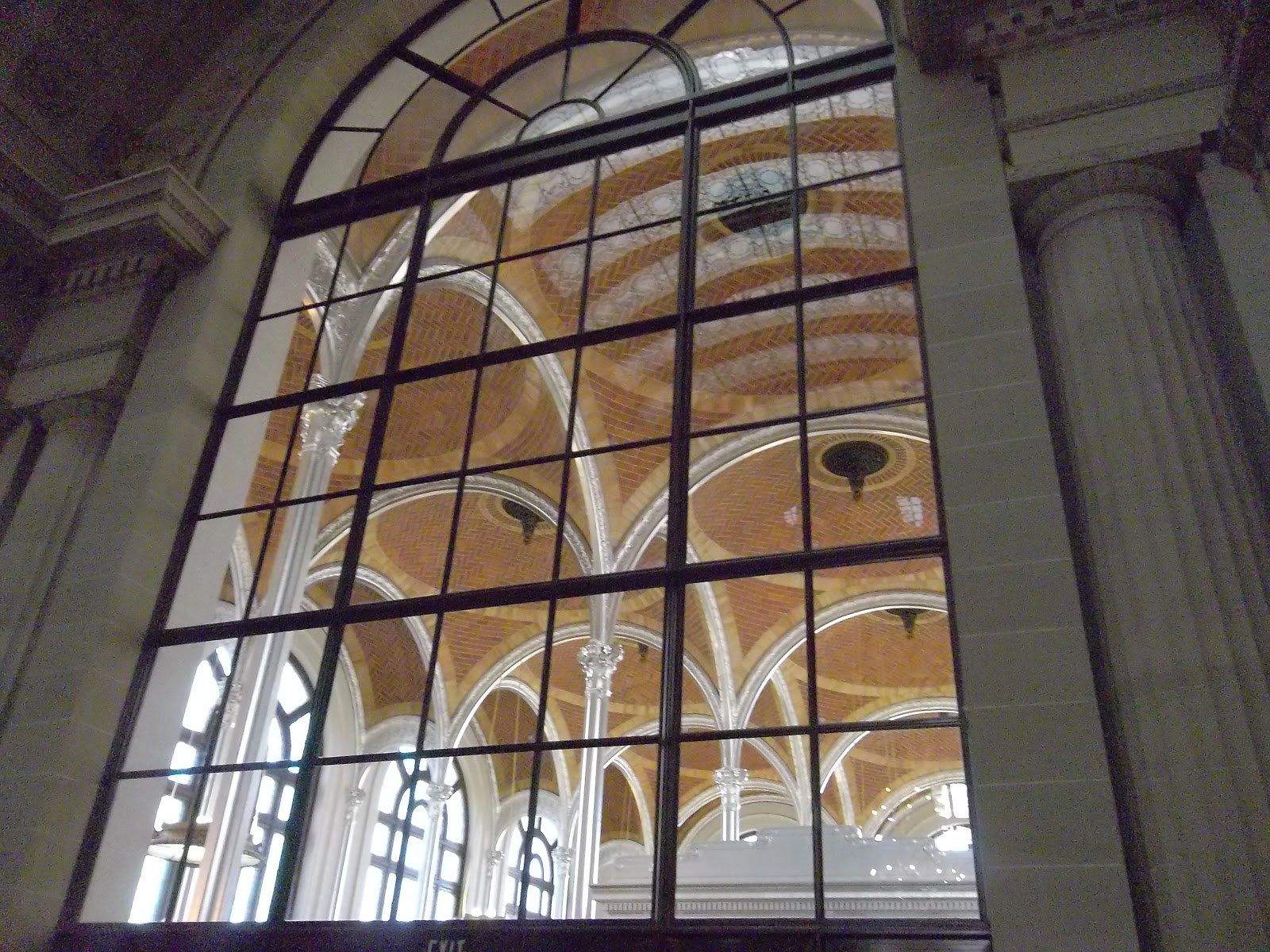
Reading Room Vaulted Ceiling

The building was scheduled to be completed by January 1, 1911, but as with many large-scale construction projects, the work took longer than expected. Unfortunately, if the building had been completed on time, the State Library, housed at the time in the State Capitol across the street, would have been spared the terrible losses it incurred when the Capitol caught fire in March of 1911.

Rotunda Chandelier
And what of the legend of the cardinal entombed in the building's stone? The cardinal in question was a pet bird with a broken wing. In fact, I have heard this story a couple of times, and at least once it was a robin, not a cardinal, that belonged to a stonemason who worked on the construction of the building. The bird died during the winter, when the ground was frozen and the mason could not bury it. Instead, he chipped a hollow space in a block of stone, laid the bird's body in it, and mortared the stone into place. No one knows the exact location of the tiny sarcophagus, but it is said to be over the front entrance or in one of the hollow columns.

Sculpted Electrolier
There is much more to learn about this magnificent example of architecture, including the sculpted electroliers by Charles Keck, the paneled room where the Board of Regents holds their monthly meetings, the seven levels of book stacks under what was originally the State Library (the Library and Archives are now housed in the Cultural Education Center, along with the State Museum), the Auditorium, now known as Chancellor's Hall, a replica of the Liberty Bell, and a series of mythically inspired murals painted by William H. Low when the building was brand new.

The following sources are a good place to start for more information about the building and its history:

"Celebrating 100 Years: 1912 - 2012 A Guide to the Education Building," The University of the State of New York, The State Education Department; Albany, NY; revised 2012

Celebrating 100 Years, NYS Education Building: Information and History: http://usny.nysed.gov/centennial/history.html

Celebrating 100 Years: Video and Slideshow: http://usny.nysed.gov/centennial/video.html

For more information about the history of the Cathedral of All Saints, go to:
http://www.thecathedralofallsaints.org/history/

Sunday, October 14, 2012

The Larkin Company - An Early Mail-Order Business

Minnie ca. 1898
When Minnie was a little girl, she used to ride with her father when he delivered wood to the villagers in Fort Plain, in his rig pulled by his horse Maude. When they had finished delivering the supplies, sometimes they would stop at the Larkin Company store and she would buy a list of things that she wanted.

Minnie also mentions in the reminiscences recorded during her later years that her mother had a Larkin chair in the house. Her mother had a Larkin club, as it was called, which would meet monthly. At each meeting, the women would "put names in something and draw them out, and every month they would have a meeting and the person whose name was drawn would have the next month's meeting."

What was this Larkin Company that Minnie mentioned? The Larkin Soap Company was founded in 1875 in Buffalo, New York by a forward-thinking entrepreneur named John D. Larkin. He had started his career in business at the age of twelve by becoming a Western Union telegraph messenger. Larkin learned soap manufacturing while working for his brother-in-law for eight years, then set up his own business.

The Larkin Soap Company's first product was a simple bar of yellow laundry soap that was marketed under the clever name "Home Sweet Soap." This was so successful that the company soon branched out into other varieties of soap, and later to a great variety of products for the home, eventually setting up over 150 chain stores in western New York State.

The real marketing genius of the company was John Larkin's brother-in-law Bert Hubbard, who pioneered the idea of mail-order sales. As an add-on to the direct sales, by offering premiums and bonuses in return for purchases, and to the housewives who hosted the Larkin Clubs, the company was able to do away with middlemen and thus cut costs. The Larkin chair mentioned by Minnie was probably a premium acquired in this way.

The Larkin Clubs were established to enable customers to buy catalog items on the installment plan. Ten housewives would set up a group and each pledge to order a dollar's worth of Larkin products. Each month, one club member selected at random would receive the $10 bonus gift, and the next month another member, and so on.

With the variety of foodstuffs the company offered, it was no surprise that they would soon solicit recipes from across the country based on the foods produced. This was the basis for the cookbook discovered in Minnie's pantry and mentioned in last week's post.

By 1893, the company was sending a semi-annual catalog to 1.5 million customers. "From Factory to Family" was the company's motto. The product line expanded continually as well; 1912, the year Minnie was married, saw 550 products in the catalog; soon an entire home could be decorated with Larkin products, from foodstuffs to furniture, china, rugs, lamps, curtains jewelry, clothing, and tableware. No wonder Minnie wanted to stop at the Larkin store with a shopping list!


Sources:

"A Brief History of the Larkin Company";  http://www.monroefordham.org/projects/larkin/history.htm, accessed 10/6/2012.

"John D. Larkin - Biography"; http://www.buffaloah.com/h/larkin/index.html, accessed 10/6/2012.

"The Larkin Soap Company"; http://www.bottlebooks.com/larkin.htm, accessed 10/6/2012.

Tuesday, October 9, 2012

The Larkin Cookbook

Another vintage cookbook has turned up in Grandma Minnie's house: The Larkin Housewives' Cookbook from 1915. Minnie wrote her name on the first page, with the date October 27, 1919.

By the line drawings of attractive homemakers and their happy families, the book gives you a window into an era when hemlines were rising and women's hair was bobbed rather than pompadoured.

The book's 140 pages are filled with 548 recipes for everything from soups and sandwiches to pickles and preserves. Imagine purchasing such a compendium of comestibles for a mere 30 cents!

The bulk of the recipes are "prize recipes selected from  more than three thousand submitted by practical housekeepers in the Larkin Recipe Contests."

On the first page of the section on sandwiches, one of the recipes was contributed by a resident of St. Johnsville, only a few miles from Minnie's hometown:


This recipe, the fourth one down on the page, sounds the most appealing to me, although I haven't tried it out yet: cream cheese and Roquefort cheese might make an interesting combination. But I would definitely reduce the quantities of all ingredients listed (and omit the butter!), unless intending to feed a large crowd, as the recipe mentions.

More about the Larkin Company next week!