Sunday, November 27, 2011

"Dainty Serving"

"The advisability of making the dishes attractive by dainty serving is not enough appreciated by the busy housewife. It seems so much easier to dish the meat and vegetables 'anyhow,' than to use the extra exertion needed to make them pretty, that she is apt to grow careless. Habit is everything in such matters. The practice once acquired of arranging the food to please the eye, as well as the palate, the added labor is taken for granted and seldom observed."

With these subtly scolding words, the Queen of the Household gently exhorts the Victorian era homemaker to pay attention not only to how food is prepared, but to how it is dished out as well. The advice is relevant even today, since in our busier-than-ever twenty-first century lives, we are apt to eat on the run or slap together a sandwich on a paper plate even at home.

Thanksgiving place setting
Fortunately, family gatherings at holidays such as Thanksgiving usually break this daily pattern. This is the one day all year that Americans of all faiths and ages trot out their best china and linens  --  perhaps the chipped Stanglware inherited from Mom and the thrice-mended lace tablecloth of Grandma's. They polish the tarnished silver spoon that came from Great-grandma's trousseau and the cut-glass Fostoria goblets that were Aunt Marg's.

Each family has its own traditional Thanksgiving recipes for turkey, stuffing, vegetables, and pies. Here are a few from Great-grandma Nan's book of household hints and recipes. They are part of the Thanksgiving menu proposed by the Queen of the Household in 1891. (See last week's post for the whole menu list.)

Turnips
Turnips:
Pare and cut into pieces; put them into boiling water well salted, and boil until tender; drain thoroughly and then mash, and add a piece of butter, pepper and salt to taste, and a small teaspoon sugar; stir until they are thoroughly mixed, and serve hot.


Sweet potatoes
Sweet Potatoes:
Sweet potatoes require from 45 to 55 minutes to boil, and from 1 to 1 1/4 hours to bake; the time given will make the potatoes moist and sweet; if, however, they are preferred dry and mealy, 15 minutes less will be enough.

Celery

Celery:

Wash, trim and scrape the stalks, selecting those that are white and tender; crisp by leaving in ice-cold water until they are wanted for the table; arrange neatly in a celery-glass; pass between the oysters and the meat.


We did not have oysters at our Thanksgiving dinner this year, but we did have the traditional turkey and stuffing, and two kinds of vegetables: carrots and turnips. These are two root vegetables, which our forebears were able to keep well in root cellars before the days of refrigeration.

The meal was scrumptious and daintily served. The colors on my plate mimicked those of the late November landscape outside my window:

Bon appetit!

But we all saved room for pie . . .

Happy Thanksgiving!  (Thank you to Margriet W. for hosting this year's feast.)

                                                                                   *  *  *

This afternoon, my husband and I drove west into the Mohawk Valley for a visit to the old homestead. We brought pumpkin and apple pies for a post-Thanksgiving treat. Flipping through old photo albums, we saw pictures of Grandma Minnie as a young adult, with her proud parents holding one toddler after another as her family grew. I feel fortunate to have those scenes of life as it was lived 100 years ago in the neighborhood where Dad grew up.

We drove homeward as the afternoon sun waned, and as we came over the crest of a hill, we could see the skyline of Albany in the distance. I slowed down as a family of wild turkeys crossed the road in front of the car. As we approached home, pink and purple streaks in the sky were reflected in the Schoharie Creek and the Watervliet Reservoir. The sun slid behind the pines as I pulled into the driveway. The long holiday weekend was over.

Sunday, November 20, 2011

"Over the River . . .

. . . and through the woods to Grandmother's house we go."

Thus begins an old holiday song that had particular significance for me as a young child.

 
Over the River and Through the Woods

It was our family custom to travel west into the Mohawk Valley on Thanksgiving, to celebrate this typically American holiday with Grandma Minnie and our aunts and uncle from my Dad's side of the family. Of course, we didn't travel by horse-drawn sleigh as portrayed in the video, but instead by car over the highway. Even if the road was sometimes snowy, most often it was plowed.

When we arrived at Grandma Minnie's house, after warming up with snacks and beverages, a dozen or more family members would seat themselves around the large table in the dining room, extended out to its maximum length for the occasion.

The table boards seemed to groan under the weight of the turkey and other dishes prepared once a year for this special feast. Minnie would always prepare creamed oysters for Dad, and there would be several varieties of pie for dessert  --  pumpkin, blueberry, and mincemeat.

After dinner we would retire to the parlor, where Aunts Glenadore and Charlotte would entertain us with piano and violin, until it was time for us all to gather around the old Victorian era upright with its trilling tremolo, to belt out, "Swing the Shining Sickle," a harvest song from the 1920's.

Only then was it permitted to turn on the television for the inevitable football games, which Dad watched while we kids dozed on the sofa, overcome by a surfeit of soporific turkey flesh and other goodies.

My earliest memories of these holiday gatherings include my great-grandmother, Kittie Van Slyke, who was born in 1868, and who lived to be 94 years old. It was she who owned the book of household hints and recipes, "Queen of the Household," which has been passed down to me along with Minnie's handwritten notebook.

Queen of the Household - Frontispiece
While leafing through the crumbling pages of this 120-year-old volume earlier this afternoon, I wondered how families in the Mohawk Valley celebrated Thanksgiving in Kittie's young adulthood. The holiday was declared an official day of  thanksgiving and praise by President Abraham Lincoln a few short years before Kittie was born. Perhaps by the time her cookbook was published, some traditions had already emerged.

Sure enough, on page 531, in a chapter entitled "A Year's Bill of Fare," I came upon a suggested menu for Thanksgiving dinner:


                                                Thanksgiving Dinner

Oyster soup                    
Celery
Roast Turkey, with Cranberry Sauce
Mashed Potatoes
Baked Sweet Potatoes
Mashed Turnips
Roast Pig
Carrots With Cream
Boston Baked Beans
Minced Cabbage
Pumpkin Pie
Plum Pudding
Fruit, Nuts, Cheese
Tea and Coffee

With the exception of the roast pig, plum pudding, and perhaps the oyster soup, the menu is not so different from the typical Thanksgiving fare of today. Stay tuned; perhaps I'll try out a recipe or two this Thursday . . .

Sunday, November 13, 2011

A Home of Their Own

Elisabeth & Barend, with baby Jake 1912
As their family grew, Elisabeth and Barend began to realize that the apartment on Third Avenue was too small. In the early 1920’s, they purchased a plot of land on the outskirts of Albany, near where the Eagle Point Elementary School now stands. Today, seeing the paved streets and rows of houses in the neighborhood where I grew up (a block away from “the old homestead”), I try to imagine what it must have been like there in that previous era. The main road, Route 20, was paved, but there were no streets yet adjacent to their house. The family had to walk through a grassy field to get to the road, where a trolley would take them downtown. 

With his carpentry skills, Barend built a small house, then a larger one for the growing family. They planted fruit trees and a grape arbor in the lower lot next to the house. The only thing missing to replicate the bucolic environment of their rural villages in the Netherlands was  a cow to provide milk for the children.

But where to find a cow in New York State’s capital city? Across the Hudson River in rural Rensselaer County lived another Dutch family who owned several cows, and who agreed to sell a Holstein named “Baasje” (“Bossie”) to the VandenBerghs. The only catch was, lacking a truck to transport the cow home from the farm, Barend would have to walk the animal from Castleton on the eastern side of the river to the western edge of Albany, a distance of twelve and a half miles (20 kilometers). This journey must have taken about six hours, with Barend leading the bovine slowly along the river, past Poplar Island, Cow Island, Bear Island, and Cabbage Island, across the river at Rensselaer, and along Route 20 to Beacon Avenue, perhaps stopping here and there along the way, wherever he could find water for the thirsty animal.

It must have been worth the journey, because eventually the family owned three or four cows, including a calf which became a family pet. It was this calf that had the unfortunate fate of being slaughtered for beef steak, as the children watched horrified from an upstairs window. After that experience, the family determined that they would never do such a thing again. 

But they continued to enjoy the fruits of their labors, and of their garden in the lower lot.

VandenBergh family 1937, in lower lot with blossoming fruit trees

                                                                              *   *   *

I don't know whether the family grew endive in their kitchen garden, but if so, Grandma may have prepared this stamppot recipe from her cookbook. Endive is quite bitter, and thus an acquired taste, but in this recipe the bitter flavor is mitigated by the blandness of the mashed potatoes.


Stamppot With Endive:

Ingredients:

- 5 or 6 small or 3 large potatoes
- 3 endives
- 1/2 teaspoon salt
- 1 - 2 tablespoons butter or margarine

- Peel and rinse potatoes. If using large potatoes, cut in quarters.

- Place the potatoes in salted water, just barely covering the potatoes.

- Lay the washed and trimmed endives on top of the potatoes, so that they will be steamed as the potatoes boil.

Boiling potatoes with endive


- Cook until potatoes are tender, 20 to 25 minutes.

- Drain so that there is about a half inch of water in the bottom of the pan.

- Mash the potatoes and endive together, with a tablespoon or two of butter or margarine.

Stamppot with endive

Sunday, November 6, 2011

Gathering Nuts -- Montgomery County, Late 1940's


It was a sun-dazzled late autumn afternoon, much like today. We don't know the exact date, but the photos may have been taken the year Mom and Dad were married (1946); if so, it was probably not more than six weeks after their wedding. Mom and Dad enclose the rest of the party like bookends: Mom in a pinkish skirt and sweater set, and Dad in a blue shirt or sweater, frozen in the act of tossing a stick at the tree branches to shake down a few more nuts.

This is the only slide in the series where I can positively identify each of the figures. Moving right from Mom, we see Dad's sister Doris, Grandma Minnie, and sisters Charlotte and Margaret. I can hear their voices as clearly as if I had been there that day  --  Grandma Minnie exclaiming, "Land sakes, Bill, don't hit your sister with that stick!"

Mom stands a little apart from the family group, perhaps still a bit shy with her new sisters-in-law, or perhaps simply not dressed for the occasion, not having known that the visit to the in-laws would include an excursion to the countryside to gather nuts. Otherwise, why the pink skirt and high heels? I'm sure she wanted to make a good impression on Dad's sisters.


Just as the figures in the photos are frozen in mid-gesture, the sunny afternoon in central New York seems congealed in time, at the cusp of the changing seasons and times. It was like that moment when the sun tinges the treetops with gold just before it makes its way over the rooftops to bathe the entire landscape in light.

In history, this moment was the pause after World War II, when horror gave way to hope, the GI's came home, and reconstruction was about to begin in Europe. The returning soldiers would fuel not only an economic boom, but a baby boom as well. The babies born that year are now in their sixties and collecting Social Security.


Today we turned the clocks back one hour ("Spring ahead, fall back"), to return to Standard Time from Daylight Savings Time.

But we can't really turn the clock back, certainly not to that autumn afternoon of 65 years ago. We can only look back and ponder with hindsight at time's relentless march, and at what we know now that the figures on that idyllic afternoon didn't know: a creeping mass of frigid air known as the Cold War would dampen spirits for the next few decades in spite of the hopefulness of the present moment.


And what would the family do with the nuts they gathered that day? It is difficult to tell what kind of nuts they were, perhaps chestnuts for a Thanksgiving stuffing recipe, or maybe some other variety that Minnie would use in one of her recipes for fruit conserves.


I have not attempted any of these recipes yet; they call for enormous quantities of fruit and sugar, but curiously no pectin such as we would expect as a thickening agent in a modern recipe for jam or jelly. The fruits used may naturally contain a certain amount of pectin, which may also be the reason for the inclusion of the grated orange rind. The purplish blots on the paper indicate that Minnie must have used at least one of the recipes and dripped a few drops of the fruit mixture while testing whether it had jelled or not.

If any reader tries one of the recipes, please let me know how it turned out!

Thank you to Margriet W. for scanning these slides.

Sunday, October 30, 2011

Settling In

If Elizabeth and Barend had looked a block and a half north when they stepped out onto Broadway as they left Albany’s Union Station, they would have seen an old Dutch-style house called coincidentally the Vandenburgh (with a “u”) House.[1] Demolished in the 1940’s, it was one of the last remaining physical reminders of Albany’s Dutch colonial origins. 

Albany received its city charter in 1686, but settlement by Europeans in this riverside port area goes back to the early 17th century, when the Dutch West India Company began trading for furs with the rival Mohican and Mohawk peoples who inhabited the nearby islands and forests. If our grandparents had looked a block or two west from the train station, they may have been able to glimpse the First Church of Albany, whose pulpit, carved of Flemish oak and adorned with an hourglass to time the Dominee’s sermons, was brought from Amsterdam in 1656, purchased for the grand sum of twenty-five beaver pelts.[2] The church's current building dates from 1797.

According to census records, when Barend and Elizabeth arrived in Albany, the city's population  was just over 100,000; it would grow to 135,000 in the next forty years, when it began to decline due to migration to the suburbs.   

New York State Capitol - Roof renovation 2011

Albany’s Capitol building was undergoing major renovations in the spring of 1911, in the aftermath of a devastating fire earlier that year that had collapsed a large portion of the building, decimated the museum collections, and virtually destroyed the State Library that the building had housed. (Coincidentally, a project to restore and renovate a different section of the building's roof is taking place as I write this.) Also damaged in the tragic fire were priceless archives that documented Albany’s early Dutch history.[3] In mid-1911, the State Education Department, which was to be the new home of the library, archives, and museum, was nearing completion across the street from the Capitol.

New York State Education Building

Barend and Elizabeth settled in Albany’s South End, a warren of two-story homes inhabited by immigrants from the Netherlands, Germany, Ireland, Poland, and Italy. Family lore has them living, appropriately enough, on Elizabeth Street. But the 1920 census record shows their address as 75 Third Avenue, which is just around the corner from Elizabeth Street. Barend is mistakenly listed as “John VandenBerg”; his occupation is shown as carpenter. Elizabeth kept house and looked after the couple’s five children born by that time: Jacob, Elizabeth, Louisa, Jasper, and Grace (my mother, who is listed as a six-month-old in the census report). Stepping out on the “stoop” to look for playmates, the children must have heard a polyglot stew of languages and inhaled the rich aromas of spaghetti sauce, kielbasa, and corned beef and cabbage, as well as their mother’s traditional stamppot.

Church on Jay Street

On Sundays the family walked a mile or so to the Fourth Reformed Church on Jay Street. Coincidentally, one of the couple’s great-grandchildren now lives on that block, almost directly across from the now-abandoned church. Jay Street is one of the last streets in Albany to still have the old cobblestones, probably placed in the 1920’s, now picturesque although showing their age.

Jay Street, Fall 2011

Grandma Elizabeth’s cookbook, Eenvoudige Berekende Recepten (“Simple Hearty Recipes”) contains the following recipe, which she may have cooked for her growing family on Third Avenue. It is as tasty today as it was a hundred years ago.

 Stamppot with Apples and Bacon

-        1 kg. (2 pounds) sour apples
-        1 ½ kg. (3 lbs.) potatoes
-        400 grams (about 1 lb.) lean bacon
-        10 gr. (2 teaspoons) salt

- Wash the bacon with warm water and cook it for about half an hour in ½ liter (2 cups) boiling water.

- Peel and rinse the potatoes, and set them to cook in the same pot with the bacon, adding the salt.

- Peel and quarter the apples, removing also the cores, and place the apple quarters in the pot.

- Let all boil for about 30 minutes, taking care that the water doesn’t boil away. Add a bit more water if necessary.

- Remove the bacon from the pan and mash the apples and potatoes together. Crumble half of the bacon and stir it into the potato mixture.

- Serve with the rest of the bacon alongside or on top of the potatoes.

Stamppot with Apples and Bacon

(I used only half the amounts called for, and it turned out to be plenty for the two of us now at home.)


[1] Rittner, Don. Images of America: Albany. Arcadia Publishing, Charleston, S.C. 2000.
[2] Alexander, Robert S. Albany’s First Church. Newsgraphics Printers, Delmar, NY. 1998.
[3] Restoration and translation of these 17th century documents continues to this day under the aegis of the New Netherland Institute, funded in part by a grant from the Dutch government.

Sunday, October 23, 2011

Arrival at Last

If you haven't already read the last two posts, you may want to read those before continuing here.

Elisabeth and Barend did indeed leave Loosdrecht the day after their wedding. They traveled by train to Rotterdam, from whence they embarked on the SS Potsdam, one of the Holland America Line's huge passenger ships. Finding the correct quay among the vast maze of docks and ships must have been a challenge. At that time, and for many years after, Rotterdam was the world's largest seaport, with thousands of ships jockeying for position among its waves and wharves.

SS Potsdam 1900
I have only vague memories of Grandma and Grandpa Vanden Bergh from my earliest childhood, when they were both in their 60's. So it is difficult for me to imagine how they must have felt as a pair of twenty-somethings just beginning their life together as they searched for their ship among the floating behemoths at Rotterdam's seaport. Did they trudge along slowly with apprehension? Or trip gaily and giddily, finally out from under the watchful eyes and intrusive thumbs of parents, siblings, and employers?

Did they stride up the gangplank with nary a look back over their shoulders, or with heavy hearts and a lump in their throats as they thought of family, friends, and the fatherland they were leaving behind? We may never know for sure, but I believe that they must have had mixed feelings, perhaps a stew of apprehension and exuberance common to many who leave their countries of birth behind to seek a fresh beginning in a foreign land.

In any case, once aboard the crowded ship, Barend and Elisabeth must have felt some satisfaction that their frugality and good luck had enabled them to purchase second class tickets. In fact, in later years, Grandma Elisabeth always wanted people to know that they had traveled second class, not steerage!

The passage across the Atlantic Ocean took ten days. The ship's manifest lists their last name as v.d.Bergh, and in the far right column under Destination, "New York" is crossed out and "Hoboken" (New Jersey) is inserted, apparently the port at which immigrants who did not travel as steerage were processed. Although Barend and Elisabeth did not pass through the doors of Ellis Island, they were indeed part of the Great Immigration that took place between 1892 and 1924, when 22 million immigrants came through the ports of New York and New Jersey.  Their names are inscribed with 700,000 others on the Wall of Honor at the site of the Ellis Island Immigration Museum.

Ellis Island as seen from Staten Island Ferry

From Hoboken, Elisabeth and Barend must have gone by ferry across the river to New York City, where they found their way to Grand Central Station, which was undergoing a ten-year-long construction project during this era. The new terminal, that which we know today, would not open until 1913.

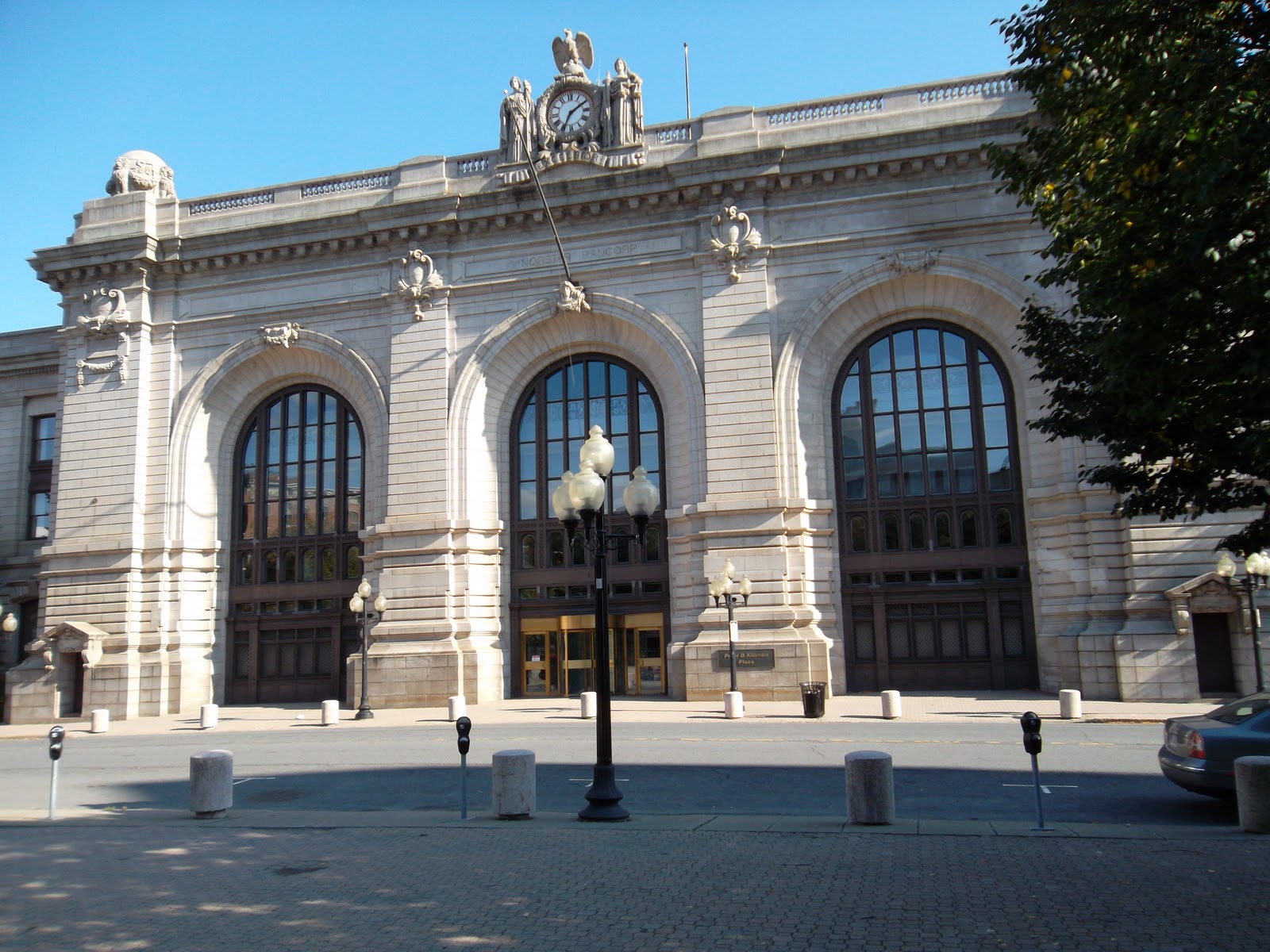
The New York Central Railroad took them the 150 miles (240 kilometers) north to Albany, the capital of New York State, where they had decided to settle.The train would have left them off at Albany's Union Station, an imposing granite structure completed in 1900. The station, now vacant, stands on Broadway in downtown Albany, across from a quiet park where government employees enjoy the autumn sun on their lunch breaks. But a hundred years ago, the area was far from quiet. Albany was a major hub for travelers, with a hundred trains a day arriving at the station from all points of the compass. Barend and Elisabeth must have stepped out into the spring sunlight dazzled by the chaos of trolleys, cars, and horse-drawn wagons competing for space along the street lined with hotels and restaurants.

Union Station in Albany, NY


Looking left and right, they caught sight of a policeman and showed him a crumpled piece of paper with a name scrawled on it -- Schij, a family from Loosdrecht who had emigrated earlier  -- and an address in Albany's South End. The officer directed them to which trolley they should board to find their friends' neighborhood, which would soon be their neighborhood as well.

To be continued . . .

Sunday, October 16, 2011

Making Plans

If you haven’t already read the previous blog post, “Starched Caps and Aprons,” you might want to read it before continuing here.

Elisabeth 1905
As Elisabeth stood staring into the empty money jar  --  a decade’s worth of savings gone in an instant  --  she heard the front door of the house slam shut. She would later learn that as she was coming in the back door on her way home from work at the Pastor’s house, her sister Louisa was going out the front door with Lijsje’s money in her pocket.  Louisa was on her way to proudly present the Pastor with a gift  --  Elisabeth’s secret cache, knowing all the while that she was actually giving his own money back to him. Ah  --  but how impressed he would be by Louisa’s wealth and generosity!

And what could Elisabeth say to her sister when she discovered the truth? At that time, their father was no longer living, and with their mother weakened by illness, Louisa, as the eldest daughter, pretty much ran the household  --  with an iron hand.

This incident may have strengthened Lijsje’s determination to start anew in another country.  In time, Elisabeth began to work in a different household. Her new employer, known only in family lore as “Juffrouw”  --  “Miss” or “Madame,” may have been either the mayor’s wife or a schoolteacher.  She apparently looked upon Elisabeth as a faithful and competent servant.

Upon Juffrouw’s death, she left a small inheritance to each of her household staff.  Her generosity enabled Lijsje to replace her lost savings  -- and then some.

Barend's family 1910
By this time, Elisabeth and Barend were apparently “courting” and making big plans. We don’t know as much about Barend’s early life, except that he also came from a large family. After completing elementary school, Barend was apprenticed to a carpenter to learn the skills involved in working with wood. Learning this trade served him well, since he worked for a wagonmaker once he and Elisabeth arrived in Albany. 

Barend and Elisabeth’s wedding took place in Loosdrecht on May 18, 1911. After the ceremony, the families had a small reception for the young couple. It was at this party that Barend  --  transformed from youth to head of household by his uttered vow and the swipe of a pen  --  stood up and announced: “Elisabeth and I are leaving for America  --  tomorrow!”

Record of marriage in Family Booklet

To be continued . . .