Tuesday, September 22, 2015

Battle of Oriskany Commemoration

Last month, I had the privilege of speaking briefly at the annual commemoration of the Battle of Oriskany. This decisive Revolutionary War battle was fought on August 6, 1777. My ancestor, Nicholas Van Slyke, was a young fifer who survived this bloody battle; in fact, there were several Van Slykes present at the battle, including Nicholas's father Gerrit.

My short talk, pasted below, gives a brief description of the battle scene, but you can find out more about the site and the battle at the Oriskany Battlefield Web site , or at the National Park Service Web page about the battlefield.

  
“Four score and seven years ago, our fathers brought forth on this continent a new nation, conceived in Liberty and dedicated to the proposition that all men are considered equal.”

I’m sure you are all familiar with the opening lines of President Lincoln’s Gettysburg Address. But we are not here to commemorate the Battle of Gettysburg, which took place 87 years after the Declaration of Independence was signed, but instead of course the Battle of Oriskany, which took place a mere one year, one month, and two days after the Declaration was signed.

The outcome of this earlier conflict was of course by no means assured at that time. But in more ways than one, it was also a form of civil war. First of all, here in what is now central New York, it pitted neighbor against neighbor, brother against brother, those we now call Patriots against the Loyalists or Tories who were loyal to the British crown. Secondly, the battle here at Oriskany represented a break within the Haudenosaunee or Iroquois confederacy, where for the first time, Mohawk and Seneca warriors fought against their Oneida brothers, who were loyal to the Patriots.

You’re probably familiar with the historical context here, with British Lt. Col. Barry St. Leger and his troops on the move through the Mohawk Valley to lay siege to Fort Stanwix, which was an American occupied garrison in what is now Rome, NY; and Brigadier General Nicholas Herkimer mustering the Tryon County Militia at Fort Dayton, the present-day village of Herkimer, with the intention of relieving the siege of Fort Stanwix.

But, as you know, General Herkimer and his troops never made it to the Fort in time. They were ambushed right here in this marshy ravine, by British and Loyalist troops under Sir John Johnson and Col. John Butler, and Mohawk forces led by Joseph Brant. Loaded down by supply wagons that could neither advance nor retreat in the crush, Gen. Herkimer and his men were caught in the bloody hand-to-hand combat that was the typical way to wage war in those days.

The site is so peaceful now, with the sounds of crickets and bird calls, that it is difficult to imagine the chaos and din of the battle on that day: the militia and British forces calling back and forth to each other in English, Dutch, and German, and their Iroquois allies in the Mohawk, Seneca, and Oneida languages. Against that backdrop, could also be heard the war cries, the moans of the dying, and the sounds of gunshots and cannon.

A couple of vignettes from the chaotic battle scene stand out in my mind’s eye: I’m sure you’re all familiar with the painting of General Herkimer directing the actions of his men from his location seated on the battleground, after being wounded in the leg, insisting that he would still face the enemy.

I picture also the Oneida war chief, Han Yerry Doxtater, who while wounded could not reload his gun, he remained on horseback while his young wife, Senagena (“Two Kettles”), repeatedly loaded the musket for him, and fired her own pistols as well.

I also cannot resist mentioning my own ancestor, Nicholas Van Slyke, who was present at the battle along with his father Gerrit. Nicholas was a teenaged fifer, whose task it was to signal, along with the drummers, troop movements or to load and fire muskets. The fife was, of course a high-pitched flute whose sound could be heard for quite a distance, even through the sounds of battle.

There is apparently no definitive list of those present at the Battle of Oriskany, including a definitive listing of survivors and casualties. So you may have seen a list that indicated that one Nicholas Van Slyke was killed at Oriskany. There were in fact, two Nicholas Van Slykes present here, since according to the Dutch naming customs of the day, children were often named after aunts, uncles, or grandparents.

But my family knows that we are descended from the Nicholas who did survive, because we have in our possession a daguerreotype from the mid-19th century that portrays Nicholas’s son David Van Slyke, born in 1787, thus the first Van Slyke in our line who was born after the Revolution.

I began my remarks by quoting from the Gettysburg address, but I’m sure I’ve gone on longer than President Lincoln did in 1863. But consistent with Lincoln’s closing sentence, it is appropriate to state here as well that those who gave their all on this battlefield also did not die in vain. The Battle of Oriskany was indeed one of the decisive battles of the American Revolution, so we owe our thanks to the brave men (and women) who fought here on our behalf.

Our democracy may not be perfect, but when we feel that it is not, we have the right, guaranteed in the Bill of Rights, to speak up and speak out, and to assemble peacefully in order to make our opinions heard, in part due to the actions of those who gave their lives here on this hallowed ground 238 years ago.

Sunday, May 31, 2015

Index to Recipes

Well, after almost five years, I've decided to retire from this blog to move on to other projects! It's been fun trying out hundred-year-old recipes from my grandmothers. I hope readers have enjoyed reading the stories and recipes as much as I have enjoyed writing and cooking.

(Well, that is, I'm pretty much retiring from the blog. I may post something again from time to time, but no longer as regularly as I have been doing up to now. Unless of course, I come across yet another heirloom cookbook that I can't resist trying out . . . who knows?!)

For anyone who would like to go back and find any of the recipes, I've added an index below.

Grandma Vanden Bergh's Recipes:

Aardappel croquetjes met ham 3/13/2011
Aardappelsla: Dutch Potato Salad 6/23/2013
Assorted Fruit Compote 6/20/2012
Beef Top Round Steak 6/5/2011
Bietensla: Dutch Beet Salad 8/24/2014
Bloemkool au gratin 4/24/2011
Bloemkoolsoep: Cauliflower Soup 11/23/2014
Cucumber and Egg Salad 6/19/2011
Drie in de Pan 1/22/2012
Dutch Apple Cake 5/29/2011
Dutch Apple Fritters 10/28/2012
Dutch Sand Cookies 3/24/2011
Fruit Soups 6/24/2012
Gebakken Vis: Fried Fish 11/2/2013
Gestoofde Kabeljauw: Baked Codfish 10/26/2014
Gezeefde Witte Boonensoep: White Bean & Leek Soup 10/27/2013
Hutspot met Klapstuk: Stew with beef rib 5/22/2011
Kerrysoep van Bruine Boonen: Curry Soup with Brown Beans 1/26/2014
Kerrysoep van witte boonen: White Bean Curry Soup 3/10/2013
Kippenkerrysoep:  Chicken curry soup 2/6/2011
Kippensoep 2/5/2012
Koffiepudding: Coffee Pudding 3/22/2015
Macaroni with Ham and Cheese 1/29/2012
Oliebollen: Dutch Doughnuts 1/1/2013
Preisoep: Leek Soup 11/23/2014
Simple White Bean Soup 5/15/2011
Snijbonen met aardappelen en rookworst 2/3/2011
Stamppot with Apples and Bacon 10/30/2011
Stamppot with Endive 11/13/2011
Steamed Pears 6/3/2012
Varkenskarbonaden: Pork Chops 4/1/2012
White Asparagus 11/18/2012
Winterwortelen: Winter Carrots 2/20/2011
Worteltjes en Spruitjes: Carrots and Sprouts 1/27/2013


Grandma Minnie's Recipes: (includes recipes from other relatives on Minnie's side of the family)


Ambrosia 4/8/2012
Apple Fritters 2/27/2011
Apple Upside Down Cake 5/29/2011
Applesauce Cake  2/9/2014
Baked Salmon Loaf 4/20/2014
Beulah's Apple Betty 4/27/2014
Blueberry Tea Cake 8/21/2011
Blueberry Tea Cake 8/26/2012
Cherry Cake 2/20/2012
Christmas Plum Pudding 12/31/2014
Cocoanut Cake 3/4/2012
Coconut Drop Cookies 2/10/2013
Coffee Cake 5/8/2011
Corn Pudding 5/26/2011
Eccles Cakes 11/30/2014
Economical Sponge Cake 9/8/2013
Escalloped Potatoes 3/6/2011
Farley's Dutch Cake 4/3/2011
Fruit and Nut Conserves 11/6/2011
Ginger Pear 6/10/2012
Grandma Minnie's Dandelion Wine 7/21/2013
Johnny Cake 2/12/2012
Kittie's Old-Fashioned Sugar Cookies 5/12/2013
Meatloaf (from Vrooman) 5/1/2011
Minnie's Bran Muffins 4/7/2013
Molasses Cookies (from Vrooman) 12/24/2011
Nut Cake 1/8/2012
Oatmeal Cookies 8/5/2012
Pennsylvania Fruitcake 12/9/2012
Raspberry Cake 9/18/2011
Rose Jar 6/10/2013
Snickerdoodles 4/29/2012
Sour Milk Cake 1/15/2012
Sugar Cookies (Minnie) 5/12/2013
Tip-Top Cake 2/10/2011
White Fruitcake 12/9/2012


Sunday, April 26, 2015

In Search Of . . . A Van Den Bergh Coat of Arms

During a recent trip to the genealogy section of the New York State Library, I came upon a large volume with the Dutch title, Wapenboek van den Nederlandschen Adel, which I translate as "Coats of Arms of the Dutch Nobility." The huge book was compiled by J. B. Rietstap, and published in Groningen in 1883.

On a partially damaged page 18, I found a drawing of a coat of arms labeled as Van Den Bergh. The drawing appears to be an authentic coat of arms, with the usual shield and plumes. Page 21 included a description of the Van Den Bergh genealogy, part of which indicates that a certain Arnold Joseph Theodore Hubert van den Bergh had the title of "procureur generaal" (comparable to the district attorney in a U.S. jurisdiction) at the court of law in s'Gravenhage (The Hague) in 1867, for which position he was granted a "diploma" which named him as a member of the nobility.

As Van Den Bergh was a fairly common surname in the Netherlands, only further research can help me ascertain whether this Van Den Bergh was an ancestor of my maternal grandfather, who was definitely not a member of the gentry or nobility, but rather a gardener on the estate of a wealthy family.

Stay tuned for more details when they arise! In the meantime, you may wish to take a look at the following earlier posts that tell more about the Van Den Bergh side of my family:

What's In a (Dutch) Name?

Excursion to Ellis Island

Scrubbing Day in s'Graveland

And a post about other coats of arms of other branches of my family:

Some Ancestral Heraldry

Sunday, March 22, 2015

Koffiepudding -- From Scratch

Our modern supermarkets make it easy to prepare and consume a large variety of sweet treats  --  too many for our own good, it seems: instant puddings and pie fillings, cake mixes, tubes of gooey cookie dough (that some of us eat without baking, I'm sure!). But our grandmothers most likely had to make their desserts from scratch, even puddings.

Earlier on in this blog, I have included dessert recipes from Grandma Vanden Bergh's old Dutch cookbook, such as fruit compote, Dutch apple cake, Dutch sand cookies, and steamed pears. From Grandma Minnie's notebook, we had molasses cookies, chocolate cookies, and a wide variety of tasty cakes. This week I would like to share a recipe from Grandma Vanden Bergh's book, for a coffee-flavored pudding. I chose this because one can easily find instant pudding packages for vanilla, chocolate, butterscotch, or even coconut pudding in the local supermarket, but instant mixes for coffee pudding are not so easy to find:

Koffiepudding  (Coffee Pudding)

8 dL. milk (3 1/3 cups)
2 dL. strong coffee (cold)  (3/4 cup)
100 grams cornstarch  (2/3 cup  --  I used 1/2 cup)
100 grams granulated sugar (1/2 cup)
1/2  - 1 teaspoon vanilla (optional)

- Bring the milk to boil with the sugar.
- In the meantime, dissolve the cornstarch in the cold coffee, and stir this mixture into the boiling milk.
- Cook over low heat until the mixture thickens (about 5 minutes).
- Pour the mixture into a mold, or into pudding cups.
- Let cool before serving; garnish with a vanilla sauce (or whipped cream).

I recall as a small child, I helped my mother make cooked chocolate pudding from a mix. I must have been about four years old, and she asked me to carefully stir the pudding on the stove while she went to answer the doorbell. Of course, I stirred it much too vigorously, pretending to be a real cook, and splattered the hot liquid all over the stove top. I was more careful this time, and didn't make a mess. I poured the pudding mixture into a ready-made Graham cracker crust:

Koffiepudding pie


I had enough left over for a small bowl or two, which I garnished with whipped cream (from a can, of course  --  I had to use at least one shortcut after all!)

Koffiepudding with whipped cream

Eet smakelijk!


Sunday, February 8, 2015

Snowbound!

Another chilly and snowy weekend in Upstate New York: temperatures have been mostly below freezing, some mornings below 0 degrees Fahrenheit, for several weeks now, and following last week's foot of snow, we are expecting another foot or so over the next day and a half. When the temperature gets to be -3 or -4 Fahrenheit, it is difficult to breathe because the frigid air makes your chest hurt.

With weather like this, it is time for some serious comfort food. Last weekend I made bruine boonen soep (brown bean soup) from Grandma Vanden Bergh's old Dutch cookbook, and right now I have a big pot of kerrysoep van witte boonen (curry and white bean soup) "prutteling" in the stove. "Pruttelen" is indeed a Dutch word for "simmer," but Mom Anglicized it by adding an English suffix.  Both of these recipes are hearty, savory soups that I have prepared before.

Bruine boonen soep


Although we occasionally have milder winters in this part of the northeastern United States, temperatures below freezing are typical of this time of the year, and even temps below zero, from time to time: witness Joel Munsell's 1854 Annals of Albany, referencing winter temperatures in Albany in 1807:

Notes from the Newspapers: 1807

Feb. 9. The mercury in the thermometer, at sunrise, stood at 52 degrees below freezing point, or 20 degrees below zero, in the central part of the city. Seventeen years previous  the mercury fell four degrees lower in an exposed situation on the hill; but it was thought that this was the coldest day ever experienced in the city since correct notice of the weather had been taken. (Vol. 5, page 12)

The weather "app" on my tablet cites a record low of -3 F. for February 9 (in 1985) and a record low of -15 F. for February 10 (in 1994). Apparently, the records referenced by the weather app do not go back as far as the mid-19th century! In any case, I was snowbound last Monday, and may very well be so again tomorrow, since the forecast is for the current snowstorm to last through until Tuesday morning. Luckily, I'll have plenty of savory soup to keep me warm. It should be finished "prutteling" very shortly.

Kerrysoep van witte boonen

Sunday, January 25, 2015

Turtle Soup!

I found an interesting recipe for Mock Turtle Soup in Grandma VandenBergh's old Dutch cookbook. I haven't tried this one out yet, but when I do, I'll post a photo:

Nagemaakte Schildpadsoep  (Mock Turtle Soup)

250 gr. (1/4 lb.) beef for soup (You can use ground beef, and roll it into small meatballs.)
1 liter (about 1 quart) beef bouillon
1/8 teaspoon ground cloves
1 bay leaf
a pinch of red pepper
1 onion
1 tablespoon minced parsley
1/2 cup grated carrot
30 grams (1/4 cup) flour
1/2 tablespoon Worcestershire sauce
1/2 tablespoon soy sauce

- Add the seasonings to the bouillon and simmer.
- Fry the  onion in a bit of butter, with the flour, taking care that it does not turn too dark.
- Stir the bouillon into the butter and flour mixture and simmer for ten minutes with the meatballs.
- Season with the Worcestershire sauce and soy sauce.
- Remove the bay leaf before serving.


A copy of Volume 5 of Joel Munsell's Annals of Albany, published in 1854, recently came into my possession. There is an interesting anecdote about turtle soup recounted on pages 276-277. Munsell indicates that the source is "a newspaper scrap, on which there was nothing by which to identify the title of the paper from which it was cut."  Below is a slightly abridged version of the story:

"Turtle Soup in Olden Times":

The early history of the first attempt at tickling the palates of Albany eipcures with that delectable chaos of flavors, known as turtle soup, was made, we believe, by the celebrated Andrew Jackson Allen, better known as Dummy Allen [. . . ]. At the time we speak of, he kept a restaurant in the vicinity of the old Green Street Theater [ . . . ], and was a prime favorite among the bloods of the day, who made his place a customary resort. Albany was then, as now, a very nice village, but still, there were some things in Dummy Allen's cookery book not dreamed of in our philosophy. He therefore resolved to afford our ancient epicures a taste of bliss in a guise hitherto unknown to them, to wit: turtle soup. [ . . . ] For a few days before the acceptable time, a sizeable green turtle was allowed to promenade at the end of a long string, upon the sidewalk in front of Allen's establishment. In due time the repast came off, and proved a complete triumph of kitchen art. The new and delicious gift to appetite became the town talk, and showered upon the immortal Dummy vast reputation and much gold. 

Once more, and while the mouths of epicures were still watering with memories of recent bliss, the potent announcement was reiterated; once more a decent-looking turtle, very like the other, divulged his ample neck on Andrew Allen's premises, to the great admiration of beholders; once more fastidious palates enjoyed select morsels of Paradise from Allen's marvelous boilers. 

Turtle soup became all the rage, and week after week it was eagerly devoured. At length, some sharp and perhaps envious observers thought they remarked a striking similarity in all of Dummy Allen's turtles. One very suspicious individual, struck with their strong coincidence of aspect, quietly took the trouble of putting his sign manual on the back of one announced for that day's slaughter. The ill-fated criminal duly disappeared, and was commented upon that day, in the form of soup, as unusually excellent. But, amazement! when next week's customary announcement of turtle soup was made, [. . . ] that same turtle, the identical, supposed-to-be-slaughtered victim of the week before, bearing the deeply cut private mark of our suspicious friend, turned up, and resumed its sidewalk promenade, apparently in capital condition for a defunct animal. The secret was out. The game was up. Dummy Allen was done for. With a regular, cheap supply of calves' heads, and one specimen turtle, Allen had been doing the Albanian epicures for a whole season. At little or no expense and with the sole aid of their imaginative powers, he had regaled them with unheard-of delicacies, and at the same time put a golden lining in his pocket. 

Source: Annals of Albany, Volume 5. Joel Munsell, 1854. 


Wednesday, December 31, 2014

A Victorian Holiday Menu

My Christmas dinner this year was a simple and low-key affair. But after the gifts were unwrapped and the guests departed, I began to wonder how my ancestors may have celebrated the holiday along the Erie Canal years ago, and what they may have prepared and eaten.

Queen of the Household - Title Page
I found a sample Christmas dinner menu in Great-Grandma Nan's 1891 book of household hints, Queen of the Household:

- Clam or Oyster Soup
- Celery
- Baked Fish with Hollandaise Sauce
- Roast Turkey with Oyster Dressing
- Roast Duck with Onion Sauce

- Baked Potatoes and Sweet Potatoes
- Baked Squash
- Mashed Turnips
- Canned Corn (This was a surprise; presumably home-canned.)
- Stewed Tomatoes
- Graham Bread; Rolls
- Salmon or other Salad

- Plum Pudding
- Peach Pie
- Fruit and Nuts

- Coffee and Chocolate

Queen of the Household - Frontispiece
I don't know how many guests this elaborate menu was intended to serve, but I surmise that it must have taken a kitchen full of helpers to prepare and serve such a repast, with three different meat and fish dishes (no, four if you count the salmon salad!), two kinds of potatoes, four vegetables, and three desserts.

Our modern hosts and hostesses may typically simplify this menu to perhaps serve only the following: turkey with dressing, baked potatoes and sweet potatoes, squash or another favorite vegetable, dinner rolls, a green salad, and a pumpkin or mincemeat pie, followed by coffee or tea.

Perhaps next year, if I am ambitious, I'll try out the recipe for plum pudding as a surprise treat for my family:

Christmas Plum Pudding:

"Shred finely 3/4 pound beef suet, and add to it a pinch of salt, 1 1/2 pounds bread crumbs, 1/2 pound flour, 3/4 pound raisins, 3/4 pound currants, picked and dried, 2 ounces candied lemon and citron together, and 1/2 a large nutmeg; mix these thoroughly, then add 4 eggs and milk enough to moisten it, but not too much or the pudding will be heavy; tie in a pudding-cloth, well floured, and boil for 5 or 6 hours [!]; or, we think better when boiled in a mold, which should be well buttered before the mixture is put in.  The mold should not be quite full, and should be covered with 1 or 2 folds of paper, buttered and floured, and then with a floured pudding-cloth."

I find it curious that in five different recipes for "plum pudding," none of the recipes actually includes plums. They list other fruits, such as tart apples, raisins, currants, and citron. Some also include nutmeg, brandy or sherry, and as in the Christmas Plum Pudding, chopped beef suet.

As I wondered about why a "plum pudding" would not contain plums, I checked the definition of "plum" in my American Heritage Dictionary, and found a less-well-known meaning: "A raisin, when added to a pudding or cake." That answered my question about "why no plums in a plum pudding."

Rather than attempt such an elaborate dessert for my next holiday dinner, I might try a simpler recipe from Grandma Nan's cookbook: Poor Man's Pudding  --  "Take 1 quart milk, 6 eggs, 6 tablespoons flour, and a little salt; bake 1/2 hour; use butter and sugar dip." Or better yet - an instant chocolate pudding from the supermarket . . . !

Sunday, December 14, 2014

Short Days, Long Nights

The shortest day of the year, the winter solstice, is only a week away. In a frenzy of consumerism, Americans are frantically shopping for gifts. I got ahead of the game this year, and mine are already wrapped and hidden away until the big day on Christmas.

But the Dutch and many Dutch-Americans have already had a fun- and goodie-filled celebration  --  Sinterklaasavond, or Saint Nicholas Eve.

As Saint Nicholas Eve (December 5) coincides with my birthday, my childhood memories of the day are a blurred combination of birthday cake, and wooden shoes filled with chocolates, nuts, and oranges.

Dutch Settlers Society Celebration:

This year, as for the past five years or so, I attended the annual Saint Nicholas Eve dinner of the Dutch Settlers Society of Albany. There was good food, music, and much gezelligheid (a Dutch word that connotes comfort, coziness, and camaraderie), a talk by Albany's Mayor about the city's rich history  --  and to top off the evening, the traditional visit by Saint Nicholas, or Sinterklaas, as he is known in Dutch.

Sweet Treats:

I also had an opportunity this week to attend a talk by Dutch food historian Peter Rose about the history and origin of Saint Nicholas lore, and the traditions connected with the celebration of this feast day, including the many recipes for tasty treats prepared for the fete.

If you have a sweet tooth like I do, you will want to try out such dainty delicacies as speculaas, most often known in the United States as "windmill cookies."

Family Mystery Solved:

Years ago, my Mom had a pair of bas-relief wooden carvings that we knew were of Dutch origin. I had a vague memory of these artifacts being displayed in the house I grew up in. And so it happened that my sister unearthed the pair, "hidden in plain sight," in the basement of the house.

The red-painted carved boards, about 13 inches by 4 1/2 inches, represent a quaintly dressed young man and woman. It was obvious to me that they were similar to the cookie boards representing Saint Nicholas and other Dutch symbols used to mold cookie dough around the holiday. But why a boy and girl? Was there a particular significance to the pair?

I learned during the talk that the paired figures are known as vrijers, or "lovers," based on the legend of the Saint's anonymous gift of dowries to three sisters whose father was too poor to provide them with the requisite sum. In this fashion, Saint Nicholas made it possible for the young women to marry.

How old are the pair of vrijers that turned up in the basement? I have  no idea, but I don't dare to try filling them with sticky cookie dough. They will, however, be a unique piece of holiday decoration this year, and a great conversation starter.


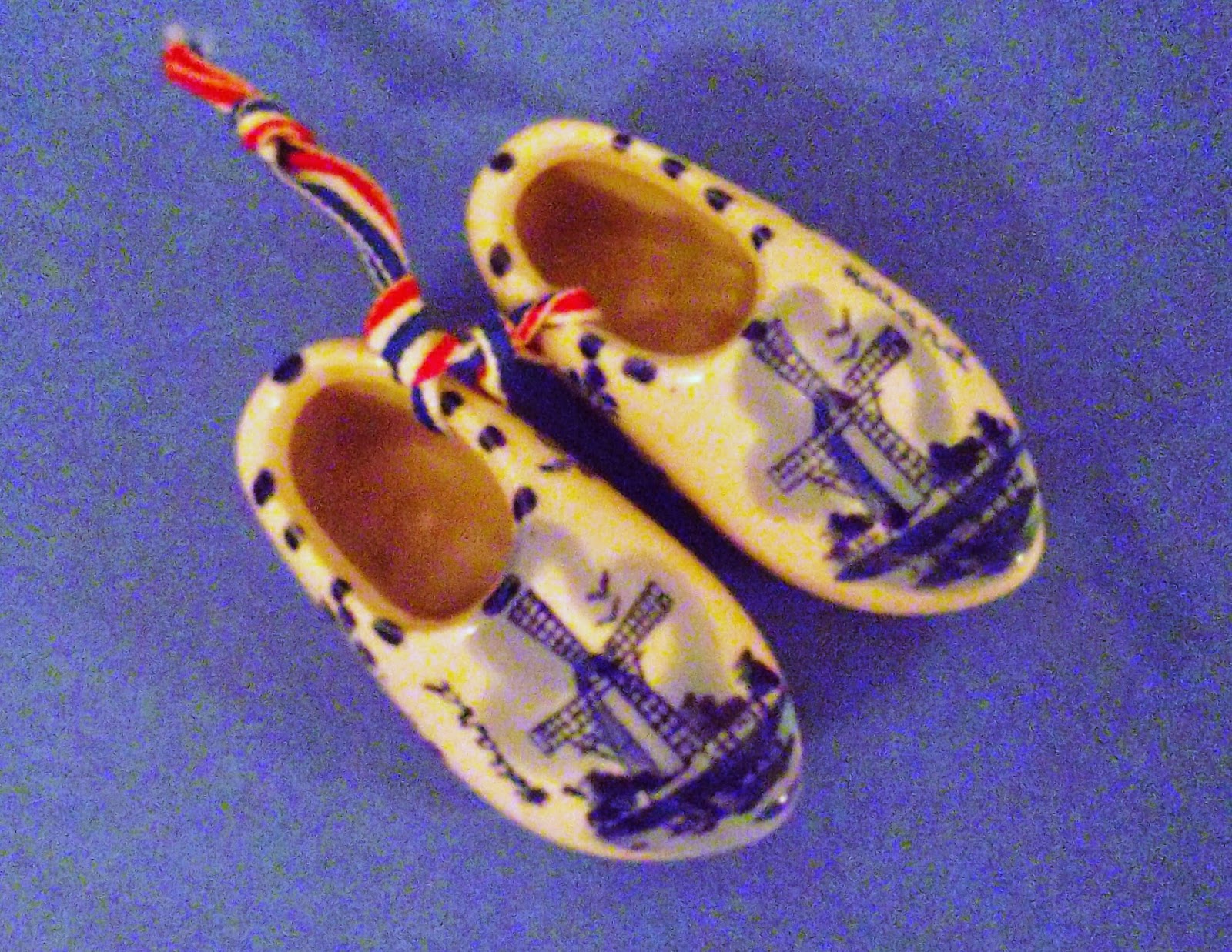
My shoes are waiting for Sinterklaas's visit!


Sunday, November 30, 2014

"Guests Raved About Her Dinner!"

Spry Cookbook - Front cover
"What Shall I Cook Today?" is the title of yet another vintage cookbook that I found in the kitchen at the old homestead. This one is a collection of recipes using the brand of vegetable shortening Spry, which was available in grocery stores between the mid-1930s to the mid-1960s. According to the brightly colored drawings that decorate the booklet's covers, "Guests raved" about dinners prepared with this canned shortening.

Published by Lever Brothers Company in Cambridge, Massachusetts, the booklet is undated, but judging from the clothing styles depicted on its colorful front and back covers, I would date it either late 1940s or early 1950s. The book contains 124 "thrifty healthful tested recipes"  --  consistent (health and thrift) in appealing to homemakers returning to the hearth after working in factories and offices while their men were fighting in World War II; consistent also with post-WW II ideals of the feminine mystique.

Deep-fried Fritters
The section on deep frying begins with a recipe for Apple Fritters, reminiscent of either Grandma VandenBergh's or Grandma Minnie's recipe; this one describes dipping apple slices in a batter of flour, baking powder, salt, egg, milk, and of course frying them in Spry. These fritters are seasoned with sugar, cinnamon, and nutmeg.

A recipe for Corn Fritters fried in a similar fashion is described thus: "Make plenty  --  everyone will surely want seconds."

Other sections in the booklet include shallow frying, sauteing, cakes, frostings, cookies, and breads, but the longest section in the book is devoted to all sorts of pies and fruit tarts. There are both two-crust pies and one-crust pies. A sticky note on the page with the recipe for Blueberry Nectar Pie indicates that our Aunt Doris used this recipe to concoct the delicious blueberry pie that was always served at our traditional family dinner on Thanksgiving, made with berries harvested from Doris's blueberry bushes in the summer and frozen until the big day in November.

Mom also always made her own pie crust dough from scratch, cutting the shortening into the flour with a pastry blender or two knives as described in this booklet: "Do not handle dough anymore than necessary"  --  to keep it light and flaky.

Spry Cookbook - Back cover
The booklet include instructions for making a Spry Pastry Mix, so that the homemaker "can have oven-fresh pies at a moment's notice." The mixture contains one pound of Spry, two pounds of flour and one tablespoon of salt; it will keep in a covered container "for an indefinite length of time." This mixture is described as "The greatest 'shortcut' in the history of pie-making. Pie crust enough for a month  --  and all in a single mixing job!" (How many pies was the 1950's-era homemaker expected to make in a month?)

Today's busy homemaker has an even greater shortcut  --  ready-made pie crust from the dairy section of the local supermarket. I suspect that many more Thanksgiving pies are made by using this commercial dough than entirely from scratch. I confess that I used it myself to try out a recipe from this booklet:

"Eccles": When I saw this word at the bottom of a page, I had no idea what it meant. This type of pastry is described as, "Titbits [sic] from your left-over pastry":

"Roll pie crust thin and cut in small circles. Place a spoonful of mincemeat or jam or fruit in center. Wet edges. Place another circle on top and press edges together. Crease three marks across top, turn, and repeat. Bake in hot oven (425 F.) 10 to 15 minutes, or until golden brown."

I was curious about the origin of this pastry treat, as well as its name. It is apparently named after the English town where it originated, Eccles in Lancashire, where a baker named James Birch began selling small, flat, raisin-filled cakes in 1793. Birch's recipe was similar to one that was included in an earlier cookbook, by Elizabeth Raffald, "The Experienced English Housekeeper."

I baked a batch of Eccles cakes and shared them with friends. The pastries were filled variously with raspberry, blueberry, and mango jam. My friends didn't exactly rave about them, but they did have seconds. (At least, I did!)


Eccles Cakes  -- fresh from the oven


                                                     *        *        *

Learn more about the origin of Eccles cakes at: http://www.salford.gov.uk/ecclescakes.htm

Sunday, November 23, 2014

Two Dutch Soup Recipes

Once again, chilly temperatures have put me in a soup-making mood. I searched through Grandma VandenBergh's old Dutch cookbook and found two recipes to try out:

Cauliflower Soup   (Bloemkoolsoep)

1 L. water (about 1 qt.), in which cauliflower has been cooked, with pieces of cauliflower in it
40 gr. (1/4 cup) whole wheat flour
40 gr. (2 tablespoons) butter or margarine
1 egg, beaten

- Use the water in which the cauliflower has been cooked, leaving a few chunks of cauliflower in it.
- Bring the water to a boil.
- In the meantime, heat while stirring the butter with the flour to form a smooth paste ("een gladde massa" in Dutch)
- Stir the boiling water and cauliflower into the butter and flour paste and let simmer for 10 minutes.
- Beat the egg in a soup tureen and carefully stir the soup into this mixture.
- Garnish with croutons or serve with whole wheat toast.

My first experiment with this recipe entailed using an unusual variety of purple cauliflower that I came across in a local farmers' market:

Purple cauliflower


This soup turned out with a pleasant shade of pink, but somehow it didn't seem very appealing to me!

Purple cauliflower soup


But ordinary while cauliflower worked out just fine:

Cauliflower Soup


Leek Soup (Preisoep)

The ingredients and preparation of this soup are quite similar, except for the leeks, of course:

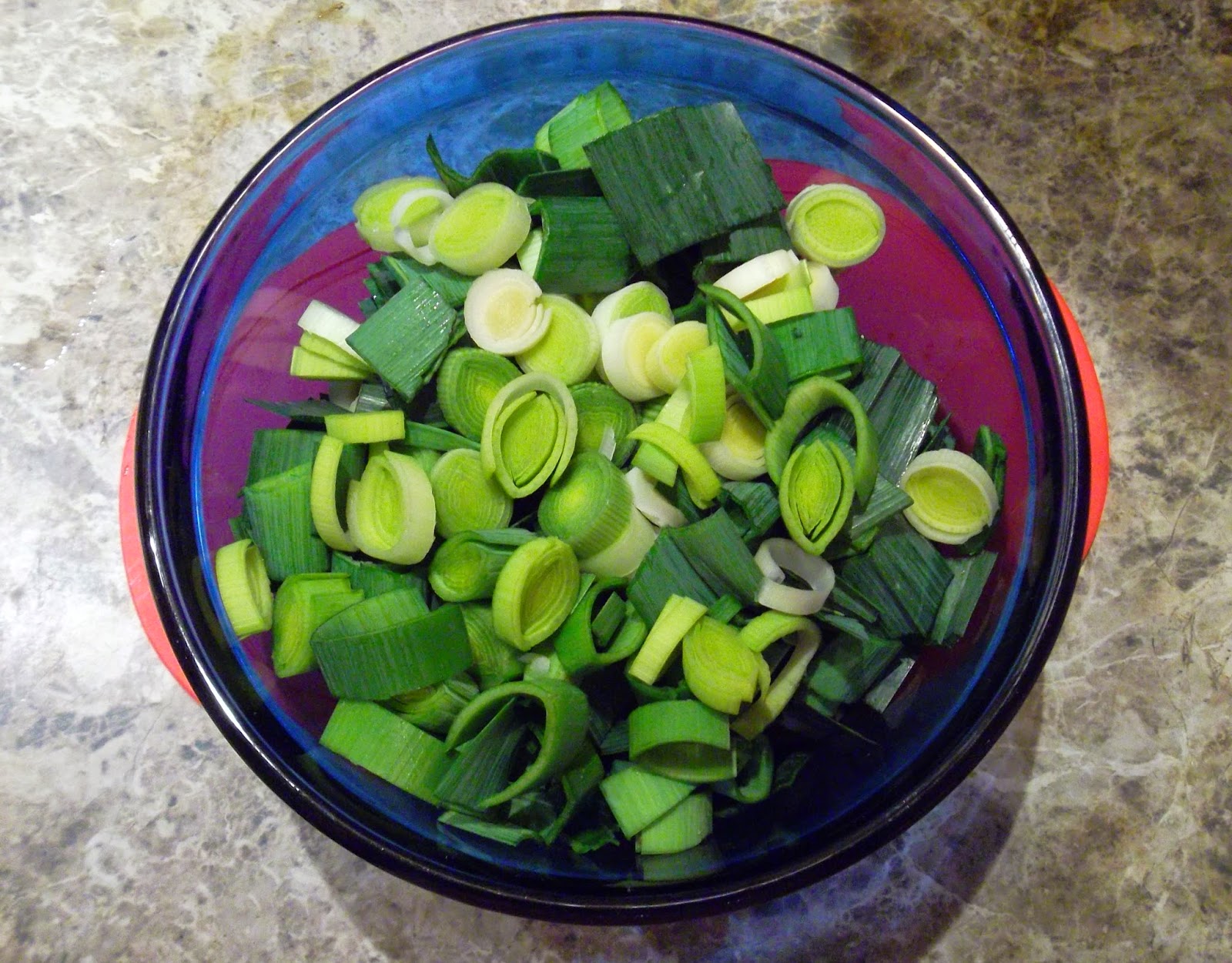
Chopped leeks
1 L. (about 1 qt.) water
7 1/2 gr. salt (1 1/2 teaspoons; I used only 1 teaspoon)
4 large or 6 small leeks
35 gr. (about 1/4 cup) flour
40 gr. (2 tablespoons) butter or margarine
2 teaspoons Arome Maggi or soy sauce
1 egg, beaten

- Chop the leeks into one-inch or half-inch pieces and cook in the salted water.
- In the meantime, melt the butter and stir in the flour, forming a paste.
- Slowly pour the liquid with the leeks into the flour and butter mixture, stirring to prevent lumps from forming.
- Let the soup simmer for about 10 more minutes until cooked through.
- In a soup tureen, beat the egg with the soy sauce.
- Stir in the liquid mixture and serve with croutons or toasted bread.

I altered the recipe a bit to add chunks of potato, to make it a bit more substantial. If you add a few bacon crumbles and consume it with whole wheat or rye toast, you'll have a whole meal:

Potato and leek soup


Eet smakelijk! Enjoy your meal.

Sunday, October 26, 2014

K is for "Kabeljauw"

Grandma Vanden Bergh's Dutch cookbook contains a chapter of recipes on how to prepare a variety of fish. That's not surprising, since the Netherlands has always been a seafaring nation, and freshwater fish also abound in its rivers.

I have tried cooking codfish from my local supermarket, but it most often tastes bland and unappetizing. I decided to try out this 1920's recipe, and found it a tastier dish than the earlier attempts I made on my own:

Baked Codfish    (Gestoofde Kabeljauw)

2 codfish fillets (about 1 kg; 2 pounds)
60 grams butter (That is 1/4 lb. I used about half that amount - of margarine.)
1/2 lemon
salt to taste

- Clean the fish in the usual way, salt the fillets and place in an ovenproof dish.
- Pour about 1 cm. (1/2 inch) of water into the dish, into which a "Cube Maggi" is dissolved, if you wish. [If "Cube Maggi" is not available, use a vegetable-flavored bouillon cube.]
- Squeeze the juice of 1/4 of a lemon over the fish and dot with butter.
- Sprinkle with breadcrumbs; lay 2 slices of lemon over the fish.
- Bake at 350 F. (175 C.) covered for 20 minutes, then uncovered an additional 10 minutes.

I served the cod with potatoes and green beans, which made a balanced meal.

Baked codfish

Eet smakelijk!  --  Enjoy your meal.

                                                              *        *        *

For another fish recipe from Grandma Vanden Bergh's cookbook, see the earlier post, "The Way of All Fish."

Sunday, October 5, 2014

More History Events

Schenectady Stockade District
This weekend I had the opportunity to attend two more history events. On Saturday I went to a Genealogy workshop at the Schenectady County Historical Society. There were four presentations.

The first was about using university archives and special collections for doing genealogical research. It hadn't occurred to me that there may be a great deal of information, for example, about the daily life of my relatives who attended college in the 1920s or 1940s in the records of the institutions they attended. A rich resource to be explored on a rainy afternoon!

The second presentation gave the attendees some tips for searching ancestry.com ; always a useful refresher for those who have tried this on their own.

The most useful presentation for me showed us how to browse through the wealth of historical information posted at a Web site developed by a research librarian at the Schenectady County Public Library. The library hosts a digital history archive which truly a cornucopia of resources that have been posted online. You can find this at http://www.schenectadyhistory.org .

The last presentation walked the participants through the resources available in the Grems-Doolittle Library of the historical association, which includes a collection of print and digital resources, including an historic manuscripts collection. The Society is located in the historic stockade district near the Mohawk River in Schenectady.

Half Moon Replica Ship on the Hudson
On Sunday, I went to the shore of the Hudson River in Albany, to tour the replica of Henry Hudson's ship, the Half Moon (Halve Maen in Dutch). The replica was constructed about 25 years ago, and is a full-scale, working model of the type of sailing vessel used by the Dutch East India Company in the 17th century. While touring the ship dockside, it was difficult to imagine how such a tiny, cramped vessel crossed the Atlantic Ocean safely.

The replica operates as a floating museum, with a crew of volunteers who welcome student sailors from local middle schools and exchange students from the Netherlands  --  a wonderful opportunity for a living history lesson!

The tour guides showed us the forecastle, where the cooking stove was located; the crew's quarters; and the area where trade goods were stored.

Stove and food samples


Storage for trade goods in the ship's hold 
Crew's quarters

                                                               *        *        *

To learn more about Henry Hudson and the Half Moon, here are a couple of books that look at the voyage from different perspectives:

Henry Hudson and the Algonquins of New York, by Evan T. Pritchard. This volume attempts to recreate the Half Moon's voyage up the Hudson river from the perspective of the Native Americans with whom the ship came into contact.

Half Moon: Henry Hudson and the Voyage That Redrew the Map of the New World, by Douglas Hunter. This book focuses on the history behind the quest for a water route through North America to the Pacific Ocean, and the economics and politics of the era.

Sunday, September 28, 2014

A Month of History Events

This month there have been quite a few history events here in New York's Capital District. Here's a list of the ones I have attended:

- Sunday, September 14, 2014: 90th Anniversary Celebration of the Dutch Settlers Society of Albany. The DSSA was founded in 1924, in connection with the celebration of the tercentenary of the settlement of the City of Albany. Its mission is to: perpetuate the memory of the individuals who resided here during the time it was a Dutch colony; collect and preserve records and information concerning the history and settlement of Albany and its vicinity, including genealogical records of the settlers and their descendants; and to foster the study of the early history of the City of Albany.

The anniversary luncheon took place at the Stockade Inn in the city of Schenectady, with fifty members and friends in attendance. The Mayor of Albany, the Honorable Kathy Sheehan, was an honored guest.  A speaker from the Historic Albany Foundation gave an illustrated talk on what the city of Albany was like in 1924, when the Society was founded. Attendees found the table of DSSA memorabilia an interesting trip through the Society's history. An album of photos taken at the celebration can be found here.

Friday, September 19, 2014: Talk and book-signing by Professor Susannah Shaw Romney, at the Albany Institute of History and Art, about her recently published volume, New Netherland Connections: Intimate Networks and Atlantic Ties in Seventeenth-Century America. I found a brief mention of my ancestor Cornelis van Slijck in her book, so I could not resist purchasing it!

Saturday, September 20, 2014: New Netherland Institute Seminar, at the New York State Museum. The Seminar featured speakers from several universities in the United States as well as from the Netherlands. There were 150 attendees this year, who filled the auditorium with their enthusiasm. Following the seminar, attendees enjoyed a dinner at Albany's historic Fort Orange Club.

Indian Statue in Schenectady Stockade Area
Saturday, September 27, 2014: 54th Annual "Stockade Walkabout" in Schenectady, NY's historic stockade district, sponsored by the Stockade Association and the Schenectady County Historical Society. The buildings on the self-guided walking tour represent three centuries of local architecture and history. Of course, there are few, if any, buildings that date from the 17th century left, but there are indeed several that were originally built during the early 18th century. In contrast with nearby Albany, Schenectady's business sector moved away from the area of the original settlement, leaving the oldest part of the city mostly residential, which surely saved many old homes from being torn down to set up businesses.

I was particularly interested and intrigued to see the names of a couple of my ancestors on historical plaques adorning homes along one street. The plaques indicate where the original homes were, but are on structures that were built later than those inhabited earlier by the original settlers:


And another plaque indicated the location of Jacques van Slijck's early tavern, near a narrow street known as Cucumber Alley:


One of the oldest houses in the city of Schenectady is the Yates house; it dates from the early 18th century:

Abraham Yates House


Halve Maen Replica Ship
Sunday, September 28, 2014: Early Albany Hudson River Festival. At this day-long festival and encampment, the replica ship of Henry Hudson's 1609 voyage of exploration, the Half Moon, or "Halve Maen" in Dutch, lay at anchor in the river. We also saw demonstrations of 17th-century handcrafts and technology, such as a cooper, blacksmith, and broom-maker. Members of the Stockbridge-Munsee band of Native Americans were also present to interpret current and past practices of their tribe.

It was right around the third week of September 1609 that Hudson's ship reached the area near present-day Albany, in the heart of what was then the main population area of the Mahican Indians. As the replica ship floated near the riverside park, it was tempting to try to visualize what the scene may have looked like four hundred years ago. The replica ship is a floating museum, with a multinational crew of volunteers and student sailors.

Mahican Wigwam Replica at Hudson River Encampment

The Half Moon will still be docked in Albany for the next couple of weekends. Perhaps I'll have an opportunity to tour the ship to get an idea of what it must have been like aboard for Hudson and his crew. 

Sunday, September 7, 2014

Excursion to Ellis Island

Grandma and Grandpa with baby Jacob, 1912
I spent last weekend in New York City, during which time I had an opportunity to take a trip via ferry to Ellis Island. Although my grandparents did not enter the United States through Ellis Island in 1911, visiting the museum there gave me a good idea of how it was for the twelve million other immigrants who were processed through that point of entry between 1892 and 1954.

Grandma and Grandpa Vanden Bergh left the Netherlands in May 1911, the day after their wedding. In later years, Grandma was always quick to tell people that they did not travel "steerage," but rather had saved enough money to purchase second-class tickets aboard the SS Potsdam. Thus, they apparently went through the customs and immigration formalities at Hoboken, New Jersey, instead of Ellis Island.

It was a thrill, though, to stand on the deck of the ferry crossing New York Harbor, and glide past the Statue of Liberty, and try to imagine what their thoughts might have been as they caught sight of the statue for the first time.


Liberty Island, from ferry

Coincidentally, as I stood on the deck of the ferry taking pictures, I heard the sound of Dutch being spoken next to me. I couldn't resist telling the family of Dutch tourists about my grandparents' passage to the United States through that very same harbor a hundred years ago. Of course, they politely corrected my pronunciation of our grandparents' hometowns, Loosdrecht and s'Graveland. The Dutch family disembarked at Liberty Island, while I continued on to Ellis Island.

The main building on Ellis Island, which now houses the museum, was opened in 1900.

Ellis Island - Museum


As I clambered up the stairs to the great hall on the second floor to the main room where the arriving immigrants were interviewed, once again I heard Dutch spoken by more tourists. It was an almost eerie echo reminding me of past generations.

Exhibits along the walls and in adjoining rooms gave a vivid idea of what it was like to pass through the medical exams, background checks, and interviews. Immigrants were scanned for contagious diseases in a six-second preliminary check-up even while they snaked up the stairs. This check consisted partly of an eye examination for trachoma, when a button hook was used to turn back the person's eyelid to check for inflammation.

Those with contagious diseases, which they may have contracted aboard ship, were sent to be cared for at the hospital that was part of the island's complex of buildings. Staff at the facility included nurses, doctors, inspectors, clerks, and interpreters for the myriad languages spoken by the newcomers.

Because of the vast numbers of people who passed through the doors, it is easy to get the idea that the process was necessarily a very impersonal one. But various details included in the exhibits do paint a picture that includes a more personal touch, for example the note that children staying at the complex were served an evening snack of warm milk; or the instruction to nurses caring for sick children "not to kiss the children" for fear of catching whatever ailment the sick child had.

After visiting the museum, I went outside to study the Immigrant Wall of Honor, in hopes of locating my grandparents' names. Although they had not come through Ellis Island, but arrived during the era that the point of entry was active, my mother had registered their names for addition to the wall. After consulting the alphabetical chart, and walking twice along the perimeter of the monument, I found them, among a number of other Dutch names: Barend and Elizabeth Daams Van den Bergh.


It would soon be time to catch the ferry back to Manhattan, but I couldn't resist taking one last photo of the skyline, in which I was able to capture the old and the new: a three-masted sailing ship in the shadow of the skyscrapers, including the new World Trade Center:

Manhattan skyline with sailing ship

And aboard the ferry on the return trip, one more photo of the Statue of Liberty against the Manhattan skyline:


                                                           *        *        *

For much more information about Ellis Island, go to the National Park Services Web site at: http://www.nps.gov/elis/index.htm  

To learn more details about my grandparents' early lives and voyage to America in 1911, you may wish to take a look at these earlier posts:

Starched Caps and Aprons

Making Plans

Arrival at Last

Settling In

A Home of Their Own

Sunday, August 24, 2014

Bientensla -- Dutch Beet Salad

Two "flinke" beets
Two "flinke" beets  --  thus begins the recipe in Grandma Vanden Bergh's 1920's Dutch cookbook for Beet Salad  -- Bientensla. The adjective can be translated here as "extra large," or "of substantial size."

The rest of the recipe calls for:

3 tablespoons vinegar
2 tablespoons salad oil
1 teaspoon sugar
chopped onion or leek
salt and pepper to taste

I used beets that I purchased at a local farmers' market. The preparation is described as follows:

- Wash the beets thoroughly.
- Cook them in ample water, with salt for about three hours [!]
- Remove the skin; let them cool, and cut in slices or cubes.
- Mix with the oil, vinegar, sugar, salt, and pepper, and if desired, the chopped onion or leek.
- Serve the salad with cold meat or cold cooked fish.

Beet Salad - 1922 Recipe


This is the simplest of the recipes for beet salad in my three Dutch cookbooks. I found that the huge beets cooked for a lengthy time (I only boiled them for half the time indicated in the recipe) did not have much flavor on their own, and a larger number of smaller beets may have produced a tastier dish.

Mom's 1961 cookbook included a slightly different recipe for beet salad, which called for six beets, six boiled potatoes, four hard-cooked eggs, two apples, and three large sour pickles. The dressing was either mayonnaise or oil and vinegar, "if [the mayonnaise] is considered to be too nourishing."

This version was also suggested to be served alongside cold meat.

In good frugal Dutch fashion, I used the leftovers from the first recipe to try this one out as well, although I omitted the apples and pickles. Of course, the potatoes and egg turned a pleasing shade of pink when they came into contact with the beet juice.

Beet Salad  -  1961 Recipe


My modern Dutch cookbook adds even more ingredients to the mix  --  300 grams of corned beef. In this version, the beets and apples are grated, and the mixture is served on a bed of lettuce leaves, with a slice of white bread to round out the meal.

I think I like the oldest recipe best, and would prefer to have the meat and potatoes separately. Whichever way you prefer your bietensla, eet smakelijk  --  enjoy your meal!

                                                  *          *          *

Language note:  My Essential Dutch Dictionary translates the Dutch word flink(e) as "tough, capable, considerable."

Mom's 1967 Cassell's Dutch-English Dictionary (first copyrighted in 1923, a year after Grandma's cookbook was published) gives a range of meanings for different contexts. Here are a few:

For objects:
     good (walk, number, size)
     considerable (sum)
     substantial (progress)
     thorough (overhaul)

For people:
     sturdy, stout, lusty, robust, strapping, stalwart, hardy, energetic

I love this versatile Dutch word flink(e) --  so useful for describing people or things!